
Summary
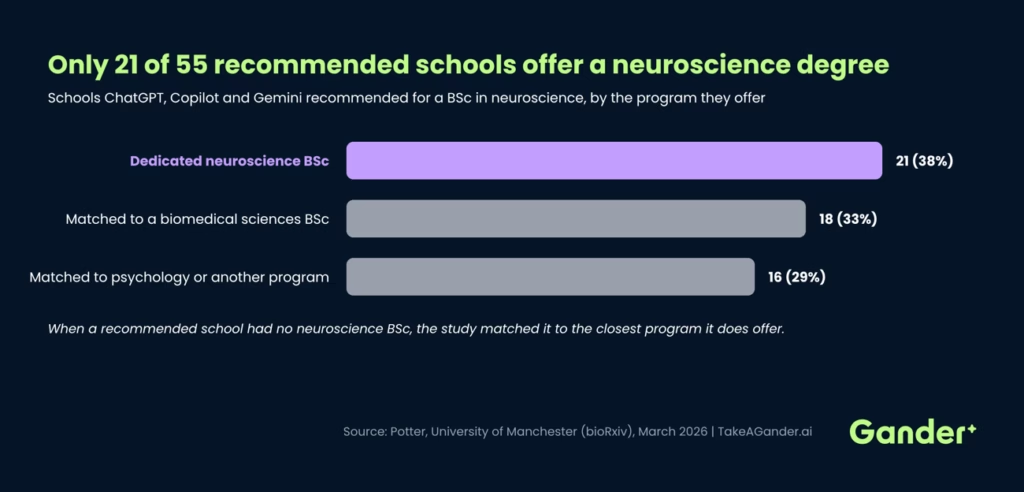
- When AI platforms were asked to recommend UK neuroscience degrees, only 21 of the 55 universities they named offered one. Students can be directed toward programs they did not ask for, while institutions offering the right degree may be overlooked.
- Accuracy and brand fidelity are separate problems. Accuracy concerns whether facts are correct; brand fidelity concerns how AI represents your institution’s positioning, strengths, and reputation. Visibility reporting alone does not measure either.
- AI recommendations change depending on who’s asking. An applicant’s grades and priorities can affect which schools appear, so a staff member’s spot check will not necessarily reflect what prospective students see.
- AI platforms search for information about reputation, student experience, programs, cost, outcomes, and admissions. Google’s AI Overviews also appear on roughly 90% of brand-name searches, meaning prospective students may encounter an AI summary of your institution before reaching your website.
- Current, detailed first-party content and sound technical foundations improve your chances of being cited. Monitor what AI tells prospective students, check it against your own information, correct inaccurate sources where possible, and assign responsibility for accuracy and brand fidelity alongside visibility.
In July 2025, a researcher named Harry Potter (really) at the University of Manchester posed as a prospective student 648 times to investigate AI search in higher education.
Across ChatGPT, Copilot, and Gemini, he asked for the five best UK universities for a BSc in Neuroscience, changing the applicant’s grades, school type, gender, and priorities each time.
The chatbots recommended 55 institutions. Only 38% (21) offered a dedicated neuroscience degree. The rest were matched to biomedical sciences, psychology, or something in the neighbourhood. Five schools took half of all recommendations.
It’s one discipline, in one country, at one point in time.
But the study identifies a practical problem—AI systems recommend schools offering related programs instead of the degree the student asked for. A university offering that degree may be excluded from the student’s shortlist, while the student spends time researching or applying to programs that don’t meet their needs. When the mismatch becomes apparent, the student has reason to question the rest of the AI’s advice.
For schools, the repercussions are practical. When a student asks for a specific program and an AI platform recommends a college or university that offers a loosely related program, schools that do offer it lose a qualified applicant. The student may not notice the mismatch until they’re well into the application, after spending time on the wrong choice. And once they do notice, they have good reason to doubt the rest of what the AI told them, including the parts it got right.
Accuracy and fidelity aren’t the same problem
AI platforms can misrepresent your institution in two ways: through inaccurate facts or by mischaracterizing its positioning. “Accuracy” is used to describe whether the facts like tuition, admission averages, intakes, co-op, are correct. Brand fidelity goes beyond individual facts. It describes whether AI represents your institution’s positioning and brand narrative correctly.
In practice, that means asking whether the model places you in the right category, whether it describes the students you actually serve, whether it repeats the strengths you’re known for or ones it has assumed, and whether it conflates you with other schools.
Both are distinct from visibility, which measures whether your institution appears in AI answers.
Yet most AI visibility reporting stops at visibility, citations, and sources, even though researchers studying brand recommendations caution that being retrieved doesn’t mean the model holds an accurate picture of what you stand for.
When Seer Interactive audited what six AI platforms said about its own agency, across 28,123 responses, the engines were right 95.9% of the time when they answered. But they declined to answer 31% of the time. On comparative prompts, 80% of responses didn’t answer at all, and only 18.8% got the facts right. It’s one agency grading itself, but the prompt that failed most often was the comparison, which is exactly the kind of prompt a student uses to build a shortlist.
This matters because people act on what AI tells them. In a Skyword survey of 1,000 US adults, 47% said they’d avoided a purchase, switched brands, warned others, or contacted a company because of something an AI tool told them. When the brand and the AI disagreed, only 29% sided with the brand.
A mention that carries the wrong facts or positioning is a mixed result at best. Some students will anchor on that information before they check your website.
Gander AI Search Intelligence compares what major AI platforms say about your institution with information on your website, identifies factual inaccuracies and brand fidelity issues, and traces them to cited sources so you know what needs correcting.
Applicant characteristics shape university recommendations
In the Manchester study, the applicant’s grades and priorities influenced which universities the chatbots recommended. As grades went up, so did recommendations for Russell Group universities, an association of 24 research-intensive UK institutions that includes Oxford, Cambridge, and Manchester itself. Asking AI the same question will produce different consideration sets, depending on who the AI thinks is asking.
For a school, this means a single check tells you very little. When someone on your team asks ChatGPT about your institution, they see the answer given to someone like them, not to the high-achieving international applicant or the mature student returning for a graduate degree. If you’re testing with a personal account, you can’t tell which of your target audiences are seeing you, and which aren’t. You simply aren’t the intended user.
What AI searches reveal about student priorities
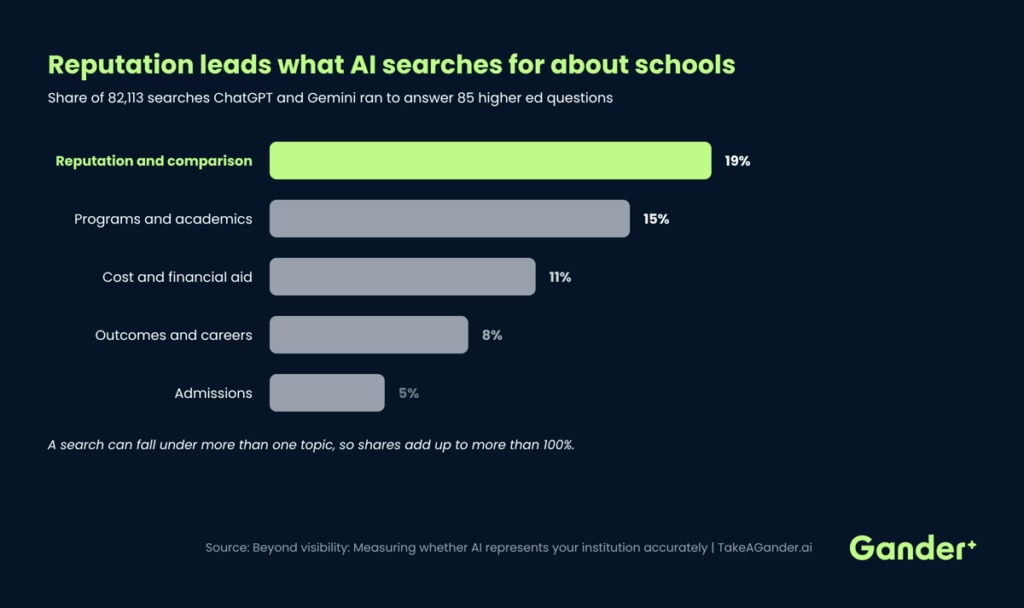
When AI answers a question about a school, it often runs its own web searches first. Google calls this query fan-out, where the engine issues several related searches across subtopics and assembles one response from the results. Across the 85 higher ed questions Gander tracked for an independent research study, ChatGPT and Gemini ran 82,113 searches, and they predominantly looked for reputation, programs, cost, outcomes, and admissions.
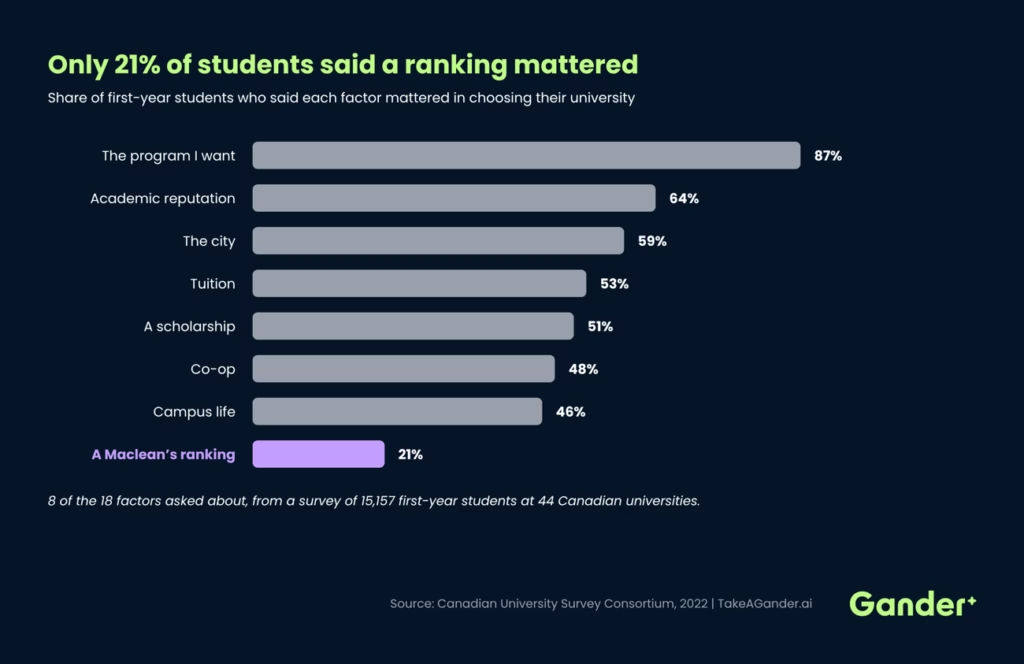
Student survey data reflects many of the same priorities. In the national CUSC first-year survey of 15,157 Canadian students, 87% said the program mattered, 64% academic reputation, 53% tuition, and 51% a scholarship. Only 21% said a Bloomberg or Maclean’s ranking mattered, which suggests rankings are only one part of how students judge reputation.
Tuition, admission averages, and employment rates are the numbers a student uses to decide where to apply, and they’re numbers an AI platform can get wrong.
Branded searches may not lead students to your website
AI Overviews now appear on most searches for a brand by name, too. SEO specialist Chris Long shared shared data showing AI Overviews on more than 80% of commercial searches, and on 96% of searches that include the word “best.” He has also observed them on roughly 90% of searches for a brand name. For a school, that includes searches like “[your school] tuition,” “[your school] admission average,” or “is [your school] good for international students.” In practice, when a prospective student searches for your institution by name, the first thing they’re likely to read is Google’s summary of you, built from whichever sources it selected, before they reach your website.
The citations attached to these summaries aren’t always reliable. SEO specialist Lily Ray identified AI Overviews linking sentences to pages that don’t contain them, and she notes it’s by design. A student who clicks through to confirm your tuition might land on a page that never mentions it, or on a rankings site, aggregator, or Reddit thread that does, with last year’s number.
Put those together and you get the path Lily describes, in which a student discovers you in ChatGPT, Googles your name to learn more, and the AI Overview sends them to a third party or a potentially another school that mentions you by name in comparison.
Inaccuracies carry more weight in this position. An error in a ChatGPT conversation reaches one student at a time, whereas an error in the AI Overview for your school’s name can appear for anyone who searches for you. Google says more inline links are coming to AI Overviews and AI Mode, which helps schools only if those links point to their own pages and those pages are current.
Google Search Console’s Gen AI reporting shows which of your pages get cited in AI Overviews and AI Mode, and Google has documented how it counts them. Since most schools already have Search Console set up, it’s a practical place to start.
What influences AI search in higher education?
Several of the signals these systems rely on are within a school’s control.
The first is freshness. Gander’s analysis of 194,077 sources found AI visibility drops roughly 40–60% for each year content ages (The 1-Year Half-Life). A program page last updated in 2023 may be passed over in favour of more recent sources, including forum threads.
The second is depth. Lily Ray found an enterprise brand’s About page earned 5x the homepage’s impressions in AI Overviews and AI Mode. It was a detailed page written for people, not one created specifically for AI. Kumar & Palkhouski audited 1,702 citations across three engines and found page quality predicted citation with 4.2x odds, led by freshness metadata, semantic HTML, and structured data.
These practices have long made program pages useful to prospective students. AI systems now use that content to answer questions for students who may never visit your website.
Steps to audit and improve how AI represents your school
- Pick 10 questions students actually ask about your top programs. Keep the wording neutral; asking “is [school] worth it?” won’t be helpful in isolation.
- Run each question repeatedly across ChatGPT, Gemini, Perplexity, and AI Overviews. Because responses are inconsistent, you’ll need at least 50 answers per question before the results are reliable.
- Check every answer against your own facts.
- Google your school’s name and see where the AI Overview sends people.
- Fix your source pages first: current figures, a visible last-updated date, one page per program.
- Check the technical basics. Make sure your robots.txt doesn’t block AI search crawlers such as OpenAI’s OAI-SearchBot, mark up program pages with structured data, use clear semantic HTML headings, and keep date metadata accurate.
- Check the third-party pages AI leans on. In the Manchester study, ChatGPT was nearly the only engine referencing Reddit and Wikipedia.
- Name an owner. Assign responsibility for monitoring accuracy and brand fidelity, and coordinating corrections across marketing, recruitment, academic departments, and the web team.
- And don’t build pages just for LLMs, since Google’s spam policy now covers mass-generated pages.
Wrap up
I’ve argued before that any tool tracking AI visibility needs to account for accuracy and fidelity, not just visibility. In higher education, students weigh a variety of factors when deciding where to apply, and AI is increasingly where they gather that information. When AI gets those factors wrong, a strong visibility score means more prospective students are seeing the error, and visibility reporting alone won’t show it to you. Errors that persist through a recruitment cycle may influence which students consider your institution, without ever appearing in your inquiry data.
Because answers vary from run to run, they’re best measured as a distribution over time. Track the trend and report accuracy alongside visibility, rather than relying on a single screenshot.
Prospective students will keep using AI to research schools, so it’s worth knowing what they’re being told about yours.
About the Author: Adam Malamis
Adam Malamis is Head of Product at Gander, where he leads development of the company's AI search intelligence platform for tracking brand visibility across generative engines, like ChatGPT, Gemini, and Perplexity.
With over 20 years designing digital products for regulated industries including healthcare and finance, he brings a focus on information accuracy and user-centered design to the emerging field of Generative Engine Optimization (GEO). Adam holds certifications in accessibility (CPACC) and UX management from Nielsen Norman Group. When he's not analyzing AI search patterns, he's usually experimenting in the kitchen, in the garden, or exploring landscapes with his camera.