
A lot of teams evaluating Gander aren’t weighing us against another monitoring platform, and they’re not weighing us against a weekend coding project either. They’re asking something much smaller: “why not just ask Claude how my brand shows up in ChatGPT and Gemini every morning, and read the answer?”
That’s not a build-vs-buy question at all. Nobody’s standing up a database or a dashboard. It’s a habit question: can a scheduled prompt do the job of a monitoring subscription? Anthropic has made this genuinely easy to try: Claude Cowork supports scheduled recurring tasks as of April 2026, available on every paid plan, and setting one up takes about the same effort as writing the prompt itself. So let’s take the idea on its own terms, because it deserves a real answer, not a brush-off.
The lightweight version is real, and it costs you almost nothing to try
Strip away the “build a tracker” framing and what’s left is genuinely simple: write a prompt asking Claude something like “what CRMs would you recommend for a 50-person sales team,” run it, and read what comes back. Mention your brand by name if you want to check positioning directly, or leave it out if you want to see whether you surface unprompted. Either way, there’s no code, no API key, no database schema, just a prompt and a few minutes to read the response.
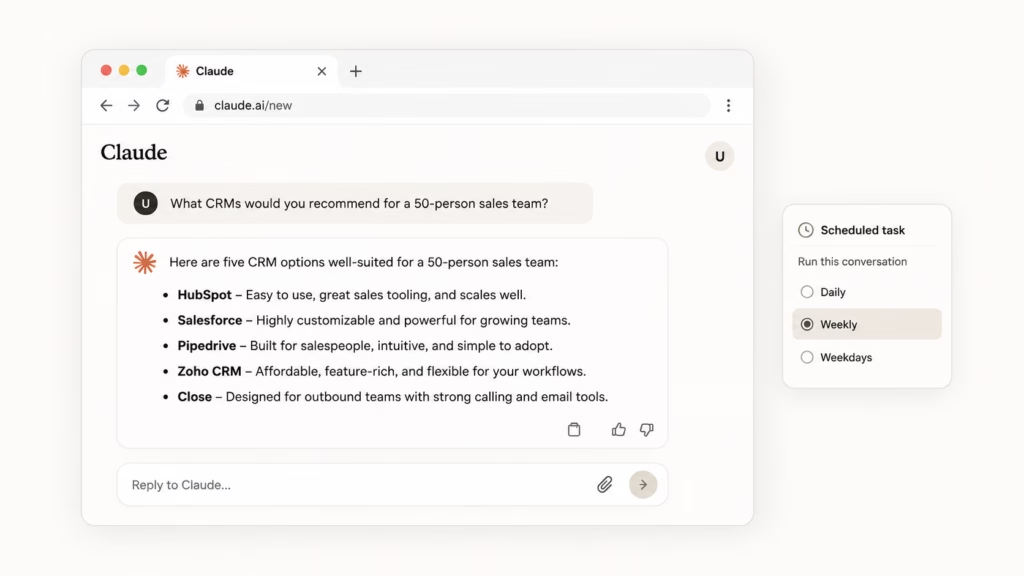
Claude’s scheduled tasks make the “check in on this periodically” part close to free. You describe the task once, pick a cadence (hourly, daily, weekly, weekdays), and Claude runs it as its own session each time, delivering the output like any other Cowork task, using whatever connectors or skills you’ve already got set up. Anthropic’s own documentation walks through exactly this pattern for “recurring research: track topics, competitors, or industry news on a regular cadence,” and a brand-visibility check is a completely reasonable instance of that pattern. If your computer’s asleep or the app is closed when the task is due, Cowork just runs it the next time you’re back and flags that a run was skipped, which isn’t exactly enterprise-grade reliability, but it’s perfectly fine for a personal habit.
If you don’t want to bother with scheduling at all, the manual version works too: open Claude once a week, paste in your two or three go-to prompts, skim the answers. Plenty of marketers and founders already do some version of this the way people used to check their Google ranking by hand. It costs nothing beyond a subscription you probably already have, and Claude is a genuinely strong tool for this exact kind of “ask a clear question, read a clear answer” task. Nobody should be talked out of trying it.
Where a single scheduled prompt actually falls short
The honest case against relying on this as your visibility program isn’t that it’s hard to set up. It isn’t, and pretending otherwise would just be dishonest. The case is about what a spot-check answer can’t give you, no matter how good the model is or how well you’ve scheduled it.
- One run is one sample, not a signal. Ask an LLM the same question twice and you can get two different answers — not occasionally, but as a routine feature of how these models work. A 2026 academic study on AI brand recommendations put a number on exactly this problem: querying GPT-5.2, Gemini, and Perplexity the same 250 category questions five times each (a “dice roll” protocol), the three models fully agreed on the single top-recommended brand for a category only 41.6% of the time, and that’s model-to-model agreement, before you even get to run-to-run variation within a single model. The paper’s methodological point is the one that matters here: “identical prompts produce varying responses across repetitions… single-shot queries cannot reliably characterize a brand’s AI recommendation presence,” which is why the researchers ran every query five times and aggregated instead of trusting any one response (Zatuchin, 2026, arXiv:2606.23057). A daily scheduled prompt is a slight improvement on a single one-off check, but it’s still one draw per day from a distribution that the researchers themselves didn’t trust after just one draw. It tells you what the model said this morning, not what it reliably says.
- There’s no history to compare against. A scheduled Claude task delivers you today’s answer. It doesn’t remember that three weeks ago a competitor started showing up where you used to, or that your position shifted after a product launch. You could paste every day’s output into a spreadsheet yourself and build that trend line by hand, but at that point you’re not “just asking Claude a question” anymore — you’re building the tracking layer of a monitoring product, one row at a time, manually.
- Nothing gets structured. A model’s answer to “what CRMs would you recommend” is a paragraph, maybe a list. It doesn’t arrive tagged with which competitors appeared, in what order, backed by which cited source, with what sentiment toward each brand. Reading that paragraph is easy. Turning six months of those paragraphs into “we’re mentioned 40% of the time, usually third, and our sentiment is trending down since the pricing change” is a data-extraction and classification job, the exact thing a scheduled prompt to Claude doesn’t do for you, because you didn’t ask it to and because doing it reliably across dozens of runs is real, if not enormous, work.
- There’s no competitor benchmarking. One prompt tells you about your brand. It doesn’t tell you that your closest competitor gets mentioned twice as often, or that a challenger brand nobody’s watching just started appearing in the same answers. That comparison needs the same prompts run against a tracked set of competitors, over the same time window, which is a different and larger question than “how do I show up.”
- There’s no technical layer at all. Even a perfectly consistent daily check only tells you what the models are currently saying, because it says nothing about whether your site’s schema markup, semantic HTML, or accessibility structure are actually helping a model find and cite you in the first place. That’s a completely separate discipline (structured-data and technical SEO for AI crawlers), and no amount of clever prompting surfaces it. A scheduled question-and-answer loop and a technical site audit are different problems that happen to share the word “AI.”
- And only one engine at a time, unless you multiply the work. Claude can tell you what Claude says. Getting the same read on ChatGPT, Gemini, Perplexity, and Google’s AI Overviews and AI Mode means running the same exercise five more times, in five more places, each with its own quirks (Google in particular has no clean equivalent to a scheduled task or API for AI Overviews and AI Mode at all, so a DIY approach hits that same wall on the Google side, whether you’re running it through Claude or writing raw API calls). Gander tracks all five of these surfaces from one dashboard for exactly this reason.
None of these are engineering problems. They’re the honest limits of what a single, un-aggregated, unstructured answer to a single prompt can tell you, and someone who automates around all five of them well (running each prompt many times, saving every answer, tagging sentiment and competitors, benchmarking history, layering in a site audit) hasn’t found a shortcut. They’ve built a smaller, rougher version of a monitoring product, by hand, prompt by prompt. That’s a legitimate thing to want to do. It’s also, at that point, no longer “just asking Claude a question once a day.”
When the lightweight version is genuinely the right call
This isn’t a hedge: there’s a real, common scenario where a scheduled Claude prompt is exactly the right tool and buying anything would be overkill.
If you have one very specific, rarely-changing question — “does ChatGPT recommend our clinic when someone asks about knee replacement surgeons in Denver,” say — and you’re checking in occasionally rather than tracking daily movement, and you don’t need to benchmark against three named competitors or produce a report for a client, a scheduled Claude task is a perfectly reasonable way to keep an eye on it. You’re not making budget decisions off the answer, you’re not reporting it up to a CMO, and a noisy single sample every so often is an acceptable trade for zero cost and zero setup. Naming this plainly matters more than pretending every use case needs a platform: if that’s your situation, set up the scheduled task and don’t overthink it.
Where it stops being the right call is the moment any of these become true: you need to trust the number enough to act on it or report it, you’re tracking more than one AI engine, you care how you compare to named competitors, or you want to know whether this month is actually better than last month rather than just what today’s answer happened to say.
What buying actually adds
Gander runs the same basic idea, asking the models what they say about a brand, but solves the specific problems a scheduled prompt doesn’t.
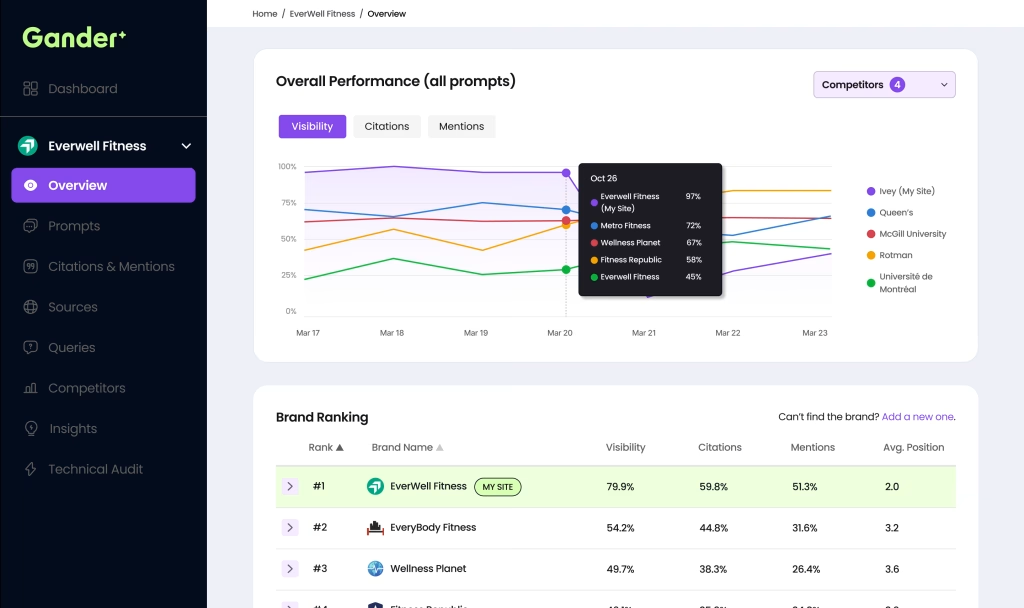
- A stable signal instead of one sample. Gander runs each tracked prompt six times during onboarding to establish a baseline, then daily after that, precisely because one run doesn’t reliably represent what a model actually tends to say, as the research above shows. That’s the sampling discipline a single scheduled Claude task skips by design.
- Five engines, one dashboard. ChatGPT, Gemini, Perplexity, Google AI Overviews, and Google AI Mode (in beta) are all tracked from the same place, including the two Google surfaces that have no clean scheduled-task or API path at all.
- Structured extraction, not paragraphs to reread. Every run is parsed into mentions, position, cited sources, and sentiment — both the AI’s own sentiment toward your brand and the sentiment of the third-party sources it’s citing — rolled into client-ready reports instead of a folder of daily text you’d have to tag yourself.
- Competitive benchmarking. Gander tracks named competitors against the same prompts, so you can see not just whether you’re mentioned but how that compares to who’s beating you and by how much, a comparison a single-brand scheduled prompt was never set up to make.
- A technical audit layer. Gander evaluates the site-level signals, things like schema markup, semantic HTML, and WCAG accessibility, that influence whether a model finds and cites you at all, which sits entirely outside what any prompt-and-read loop can tell you, however well-scheduled it is.
- Plans that scale with how seriously you’re tracking this. Pilot starts at $150/month, Optimize at $500/month, and Authority at $1,000/month, priced against daily multi-engine monitoring, competitor benchmarking, and reporting, not against a single prompt run once a day.
The real decision
Claude is a genuinely good tool for asking a clear question and reading a clear answer, and Anthropic’s scheduled tasks make it easy to do that on a recurring basis without writing a line of code. If that’s all you need — one narrow question, checked occasionally, no competitor benchmarking, no report to produce — do that, and don’t let anyone convince you that you need a platform for it.
What a scheduled prompt can’t do is turn one noisy sample into a stable number, remember what last month looked like, tell you how you stack up against named competitors, or tell you anything about whether your site is actually structured to get cited in the first place. Those aren’t things you’re missing because you haven’t automated hard enough. They’re a different job, and it’s the job Gander is built to do.
Take a look at Gander and see if your situation has outgrown the daily prompt.