
AI assistants let you tell them about yourself. Your job, your company, what you care about. ChatGPT will remember it between chats if you let it. The promise is that the answer then bends toward you.
If that promise holds, it matters for any brand trying to get recommended by an AI. It would mean there is no single answer to “who does ChatGPT recommend in my category.” There would be a different answer for every kind of buyer and getting recommended would depend on which buyer is asking. So we tested it.
What we mean by Persona
Marketers describe buyers along standard lines. We took four of them and tested each one separately:
- Firmographic is a fact about the business, like its industry, size or revenue.
- Demographic is a fact about the person, like age, gender or income.
- Psychographic is what goes on inside the person’s head, like their values, beliefs and attitudes.
- Sociographic is the groups and communities the buyer belongs to.
The reason to separate them is that they might not carry equal weight. A marketing team can spend weeks building a demographic profile of a buyer. If an AI ignores demographics and responds only to attitude (Psychographic), that team could be optimizing for the wrong thing.
How we ran it
We invented a buyer shopping for commercial cleaning, then we asked four AI platforms ten normal buying questions, for example: “what is the best commercial cleaning company to hire” and “recommend a reliable commercial janitorial service.” The platforms included were ChatGPT, Perplexity, Gemini, and Google AI Overviews, which is the AI answer box at the top of a Google search.
We chose commercial cleaning because it is plain business to business, every company buys it, and it carries no specialist jargon that might confuse any results.
First we asked all ten questions with zero context attached, which gives us a good baseline of who the AI recommends when it knows nothing at all about the buyer. Then we asked the same ten questions again with one persona detail added to the end. In practice the AI received something like this:
“What is the best commercial cleaning company to hire?
For context: I’m skeptical of big national chains, I have been burned before, and I’m very price sensitive.”
So the only piece that changed is the second line, the rest stayed identical word for word. We ran a separate version for each segment, as outlined above. So one version added the firmographic detail, another the psychographic, and so on. Changing one thing at a time is what lets us say which segment moved the needle, rather than ending up with a difference that we cannot attribute.
We then read every answer, and pulled out all the companies it recommended. Comparing those lists is how we measure whether a persona changed anything.
Why we asked everything ten times
Here is the problem that shaped this study. These platforms do not give the same answer twice.
If you ask ChatGPT the same cleaning question twice in a row, on separate instances, changing nothing, you will get two different lists of companies, with around half the names being new the second time.
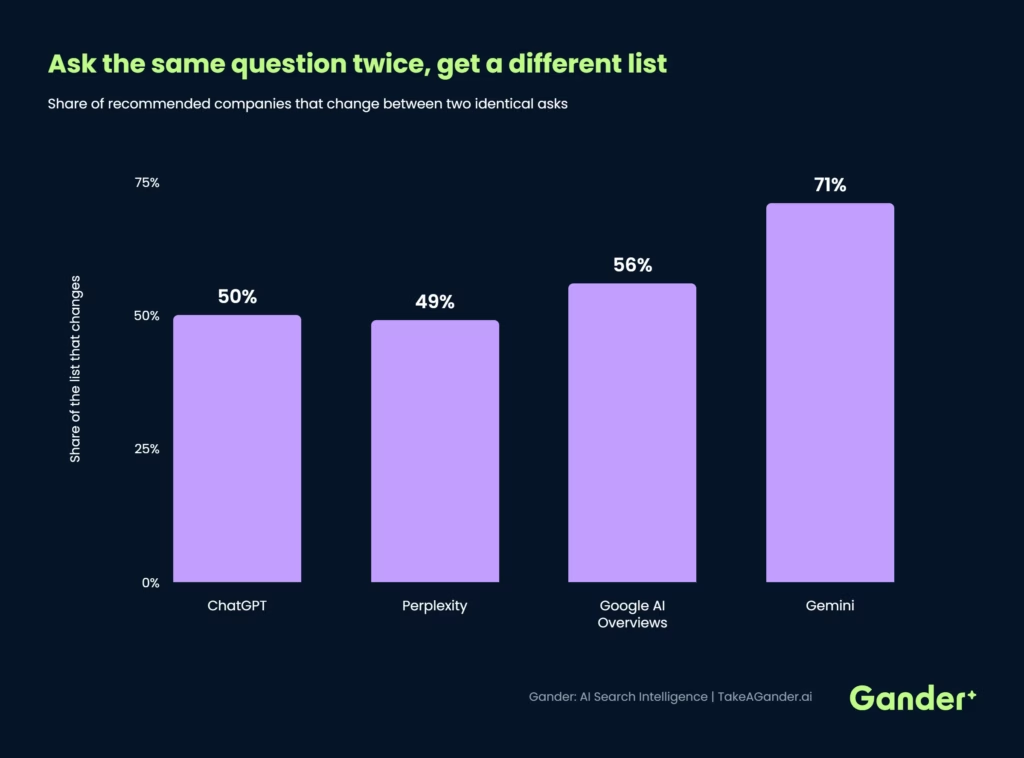
On Gemini, it’s closer to seven in ten. That instability is the most practical thing we learned, and it has some obvious consequences. One being that if you ask AI once whether it recommends your company, you have learned almost nothing.
It also sets the bar for the rest of the study. If the list of companies changes on its own without us touching things, then a persona has to change the answer by more than that natural churn before we can claim it did anything. So we ran every version of every question ten times, on each platform, giving us enough runs to tell a real pattern from other variation or noise.
Which segment actually matters
We attached each segment to the same ten questions, using this wording:
- Firmographic: “I run a mid-sized commercial real estate firm that manages several office buildings.”
- Psychographic: “I’m skeptical of big national chains, I’ve been burned before, and I’m very price-sensitive.”
- Demographic: “I’m a 52-year-old man.”
- Sociographic: “I’m part of a local business owners’ association and I prefer locally-owned, community-recommended providers.”
Then, two things were measured. First, what the answer talked about by counting how often it used language about offices and buildings, about price and value, about trust and vetting, and about local and independent providers. Second, which companies it actually ended up recommending.
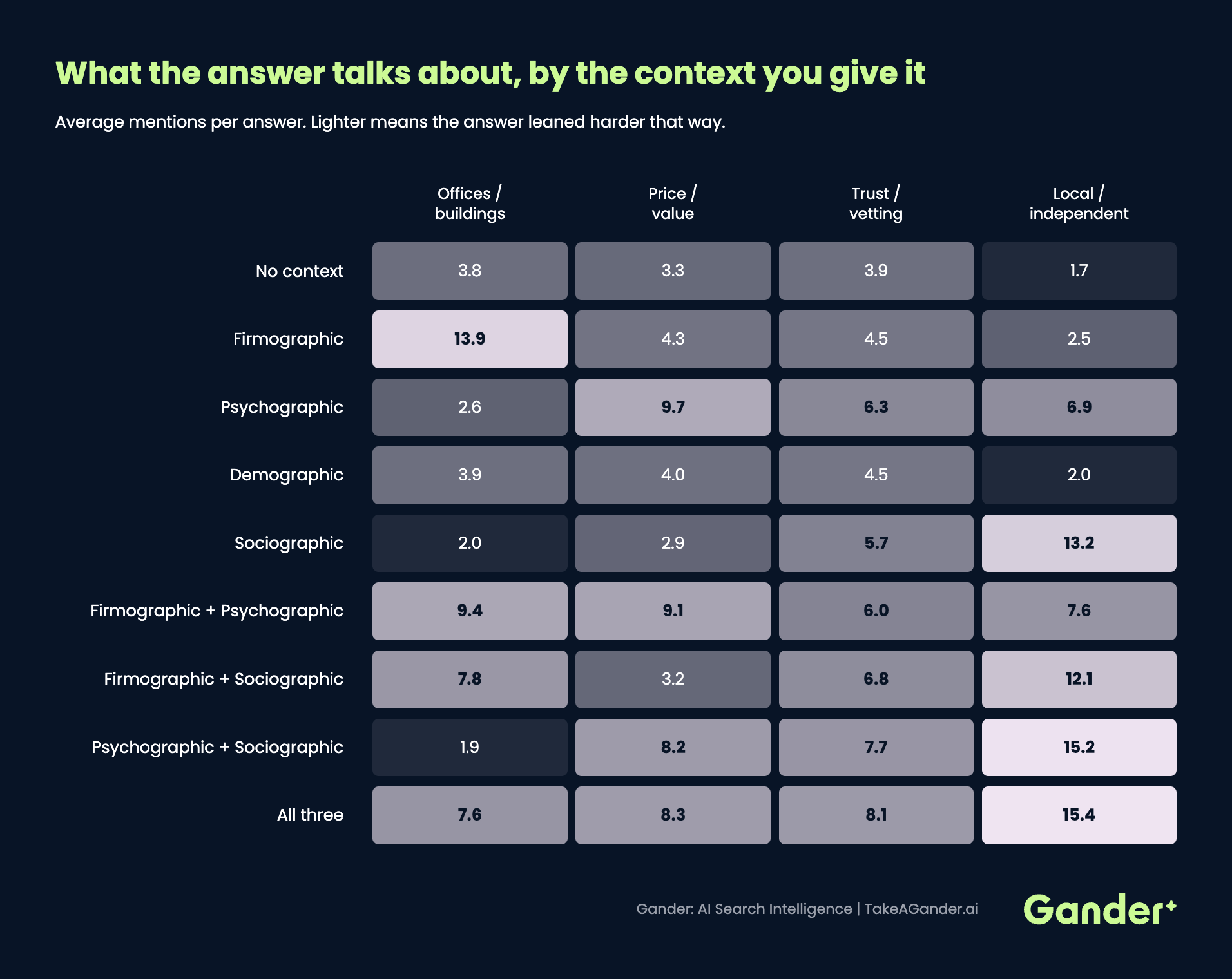
Each segment moves its own kind of language and mostly leaves the rest alone:
Attach the firmographic detail and talk of offices and buildings goes from about 4 mentions per answer to about 14. The AI starts discussing floor plans, tenants and building portfolios.
Attach the psychographic detail and talk of price and value roughly triples, from about 3 mentions to about 10. The AI starts mentioning how to compare quotes.
Attach the sociographic detail and talk of local and independent providers goes from under 2 mentions to about 13, the largest single shift we measured.
Attach the demographic detail and almost nothing moves. Every category stays within a mention or so of the no-persona baseline.
So telling the AI that the buyer is a 52-year-old man changed the answers about as much as telling it nothing at all. For business buying questions, the demographic profile has close to no effect on what the AI recommends. What these platforms respond to is what the buyer does and how the buyer thinks.
Personas change who gets recommended, not just how the answer sounds
Talking differently about price is one thing. Recommending different companies is another, and that’s what determines whether a brand shows up.
To measure it we sorted the recommended companies into two groups: the large national franchise chains, such as ABM, Jani-King, ServiceMaster, Jan-Pro and Coverall, and everyone else, meaning the smaller regional and independent operators. Then, we tracked what share of the recommendations went to the national chains. With no persona attached, about 59% of the companies named are national chains. That’s the default answer, and it favours the biggest brands.
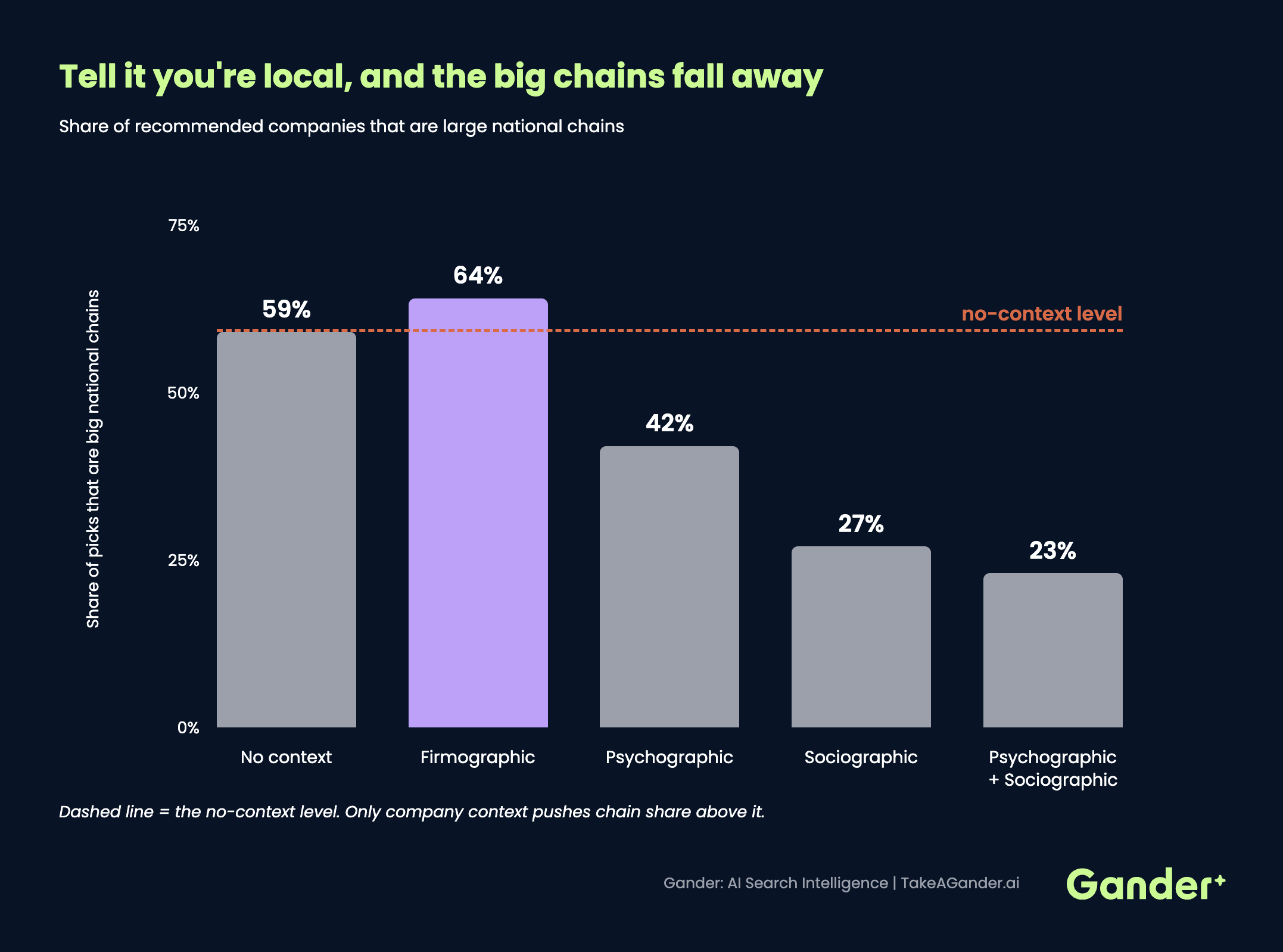
In summary:
- The psychographic detail drops it from 59% to 42%.
- The sociographic detail drops it to 27%.
- Both together drop it to 23%, well under half the baseline.
- The firmographic detail pushes it the other way, up to 64%, which makes sense, because a firm managing several office buildings is exactly the customer the national chains are built to serve.
- The demographic detail lands at 61%, close enough to the 59% baseline to count as no change.
So a buyer who mentions being price conscious and community minded gets shown a substantially different set of companies than a buyer who says nothing.
Does it matter how you tell the AI?
You can hand an AI a persona three ways. You can type it into the question, save it as a standing instruction that it applies to everything, or plant it as an earlier message so it looks like something you mentioned before. It was worth checking whether these differ, since a saved memory intuitively feels weightier than a line of text in a prompt.
They came out the same. All three produced the same shift, within the range of the platform’s normal variation. So the simple version, typing it into the question is as good as the elaborate ones.
One exception appeared when we tested a genuine back-and-forth, where the AI replies to the persona in its own words before we ask the real question. On Perplexity and Gemini, that shifted which company names came up. It doesn’t change any conclusion above, and it doesn’t make the answers more consistent.
Stack segments and the effects blend
Real buyers are never a single segment, so we combined them and looked for one of three outcomes: the effects blend, they cancel out, or one takes over.
They blend. A buyer who is both price sensitive and community minded gets an answer heavy on both price and local providers, not one at the expense of the other. When you add the firmographic detail on top, the answer covers offices, price and local providers together. There’s some dilution, since a single answer can only lean so many directions at once, but no segment cancels another.
What this means for getting recommended
If you sell to businesses, the buyer’s mindset and affiliations shape whether you appear far more than their demographics do. A price-conscious buyer and a large-firm buyer asking the identical question get different shortlists, so there is no single ranking of who the AI recommends in your category.
That gives you something practical to do. Work out which kind of buyer you win with, then make sure the pages these platforms read when they build an answer actually carry those signals. If your advantage is being local and independent, that has to be plainly stated on your site, because the community minded buyer’s answer is precisely where the national chains fall away and you can take their place.
And measure across many asks, never one.
If you want to see this in your own market, ask the AI platforms the questions your buyers ask, attach the kind of buyer you sell to, leave your brand name out, and see who comes up. Run it ten times and read the pattern rather than the single result.
About the Author: Ibraheem Azhar
Ibraheem is an AI Engineer working on GEO and AI-search research at Gander, building models ground up and running experiments like these to see how orchestration layers can be reverse engineered for insight.