
Volume 2
We interviewed 24 search professionals to understand how the industry is responding to AI search and executing generative engine optimization. This report captures their insights and thoughts.
Methodology and Research Design
The findings in this report are based on a thematic analysis of 24 qualitative interviews with search professionals (SEOs). Interviews took place between February 1, 2026 and April 30, 2026. We chose this approach to capture how SEOs are adapting to AI search while industry benchmarks are still being defined. To provide a balanced view, we categorized participants by professional grouping—agency, freelance, or in-house.
Participant Segments and Professional Classifications
We included participants from three main professional groups to cover a variety of perspectives.
- Agency (n=14)
Titles included: Founder/Owner, Director of SEO, Head of SEO, Senior SEO Strategist, Technical SEO Lead, Fractional SEO Consultant - Independent practitioners or freelance (n=4)
Titles included: Growth Marketing Consultant - Internal marketing teams (n=6)
Titles included: SEO Manager, Senior SEO Specialist, Head of Search, Director of SEO, Senior SEO
Limitations
This research provides insight into industry mental models around AI search, but it has several limitations. The sample size of twenty-four participants is large enough for a thematic study, but it does not represent the views of the entire search industry. Participants skew agency-side, meaning that freelancers and in-house teams are not evenly represented. Freelancers in particular are underrepresented this quarter relative to Q4 2025.
Because we used a qualitative approach, the findings rely on the personal experiences and opinions of the experts we interviewed. The fast-moving nature of AI search means these trends may change quickly. Finally, most participants were located in Canada, the United States, the United Kingdom, and Ireland, so the results may not apply to every global market.
Note: one in-house interview was lost to a recording corruption issue. The participant is retained in the cohort count for representational completeness but is not directly quoted in this report.
Questions Asked
Have you developed a GEO offering for clients?
If so, how would you describe its scope? If not, what factors have stopped you from formalizing an offering so far?
All 24 practitioners are doing GEO work this quarter, but most have not built it into a standalone offering. Among agencies (n=14), three (21%) have a formalized standalone product with named scope and set deliverables; the rest fold GEO into existing SEO retainers. The four independent practitioners universally bundle GEO into existing client work without a separate scope. The six in-house respondents describe AI work as added to their existing SEO function rather than as a discrete program, though one runs a structured cross-functional committee that includes AI search, SEO, development, PR, and content.
Compared to Q4 2025: the cohort has shifted from asking “should we be doing this?” to “how should we package this?” The work itself is no longer optional, and in-house teams are starting to devote time to GEO as an extension of SEO.
Do you see GEO services as a value-add to retain current SEO retainers, or is this a new, chargeable line item?
Most agencies and freelancers are still bundling GEO services into existing SEO retainers as value-add, rather than creating new revenue streams. Three of fourteen agencies (21%) reported charging GEO separately, using a scoped discovery/audit, a chargeable AI add-on next to SEO, or separate scoping for new prospects with bundled pricing at renewal.
Independent practitioners universally bundle, with no change to scope or price. One described the shift as new positioning rather than new pricing. Effectively the same work, sold under a more current narrative. Geographic and budget constraints affect pricing decisions: practitioners working in regional or smaller markets report difficulty justifying premium GEO pricing, regardless of segment.
In-house teams described GEO efforts as absorbed into existing marketing or SEO budgets. None reported dedicated headcount or standalone budget allocation for AI visibility efforts.
Compared to Q4 2025: 3 of 14 agencies (21%) now charge GEO separately, up from 2 of 11 (18%). The view that “the market hasn’t yet established GEO as a distinct billable service category” is starting to soften for larger and specialist agencies. For freelancers and most mid-sized agencies, it still holds.
“The backbone of GEO is very similar to SEO. It’s all about really high quality, original content that doesn’t exist elsewhere. Human written, not AI written… in addition to that, it’s not just the words on the page, but it’s also the quality of the code.”
— Drew Harden, Blue Compass
Have your clients asked you about AI search? If so, what kinds of questions are they asking? What information do you wish you had for them?
Most agencies report clients asking about AI search. The dominant question across segments remains “how do we show up?” The harder, more frequent question this quarter is ROI: clients want to know what specific outcomes the work produces. Practitioners describe lacking confident answers because data infrastructure is still being built.
In-house teams describe two distinct leadership patterns. First, a wave of executive interest landed roughly six months before these interviews, when leaders started asking what the company was doing for AI search. Second, ongoing pressure from those same leaders to translate visibility metrics into measurable business KPIs.
Client objections also surfaced this quarter. Pushback that companies are “not getting any traffic” despite the industry hype. Ghost sentiment emerged as a recurring theme, meaning outdated reviews and old information still appearing in LLM responses.
Most Common Client Questions
Question | Q1-26 Frequency | Q4-25 Frequency |
|---|---|---|
How do we show up / get cited in AI search? | High | High |
What’s the ROI / traffic from AI search? | High | Moderate |
Why do competitors appear and we don’t? | Moderate | High |
How do we become THE cited source? | Moderate | Moderate |
What should we be doing differently? | Moderate | Moderate |
Are we falling behind? | Low | Low |
Why is everyone hyping this when we get no traffic? | Low (new) | |
Why are old brand / old reviews surfacing? | Low (new) |
“About six months ago, everyone really caught on and executives started asking like, what are we doing for AI Search? And I’m like, I already got a plan, I kind of been doing this already… “
— Michael Farr, Paylocity
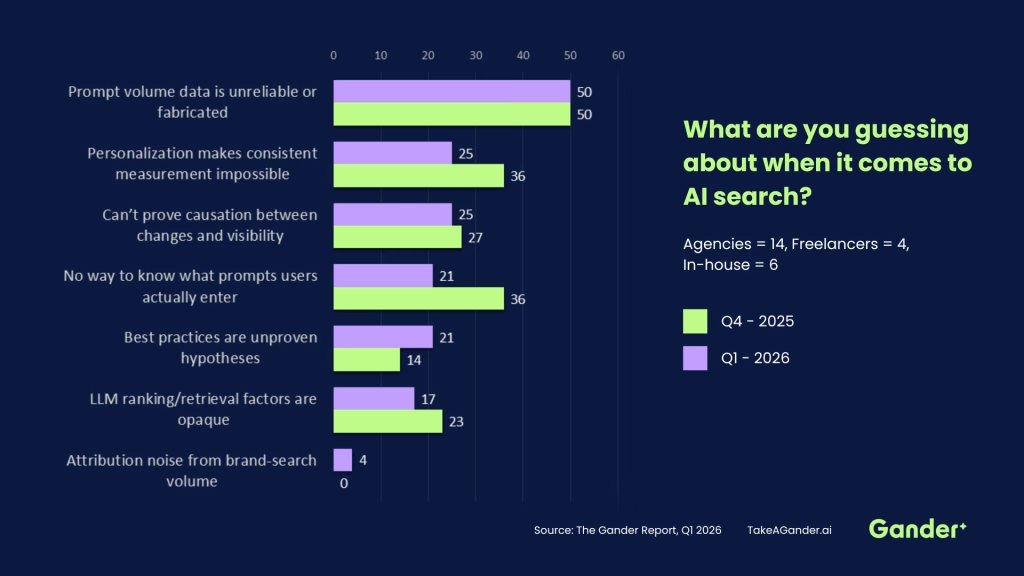
What’s the one thing you feel you’re ‘guessing’ about when clients bring up AI search?
Prompt volume data is still the universal blind spot across the cohort. Every practitioner who addressed this question expressed distrust of the available data. Common framings: “proxy data,” “deceptive,” “directional at best,” or “something to take with a bit of salt.” The skepticism extends across every major platform claiming proprietary prompt volumes.
Causation between optimization work and visibility shifts is the second-most-cited gap. Practitioners describe optimizing without a feedback loop tight enough to validate that specific changes drove specific outcomes.
Personalization and context emerged as a Q1 theme. Results vary with user history, location, and conversational follow-ups, while current visibility tools use fixed artificial context that cannot simulate real conversations or customer variance. Attribution noise from existing branded search creates a challenging signal-to-noise problem for in-house teams.
Author’s note: I strongly disagree that personas within visibility tools are useful. As a UX practitioner with 20 years experience, I’ve found that the value of personas are through the facilitation journey. Specifically, the ability to give teams common language, understanding, and empathy, leading to better service and marketing decisions.
Having Acerbic Adam as your persona and saying he likes satire, gardening, and cooking doesn’t really influence his search for an HRIS.
Gap | Q1-26 Mentions | Q1-25 Mentions |
|---|---|---|
Prompt volume data is unreliable or fabricated | 50% (12) | 50% (11) |
Personalization makes consistent measurement impossible | 25% (6) | 36% (8) |
Can’t prove causation between changes and visibility | 25% (6) | 27% (6) |
No way to know what prompts users actually enter | 21% (5) | 36% (8) |
Best practices are unproven hypotheses | 21% (5) | 14% (3) |
LLM ranking/retrieval factors are opaque | 17% (4) | 23% (5) |
Attribution noise from brand-search volume | 4% (1, new) |
Trust inside an LLM isn’t a single signal. It’s a construct built from dozens of vectors, so treating it as one variable doesn’t leave enough room for how the system actually behaves.
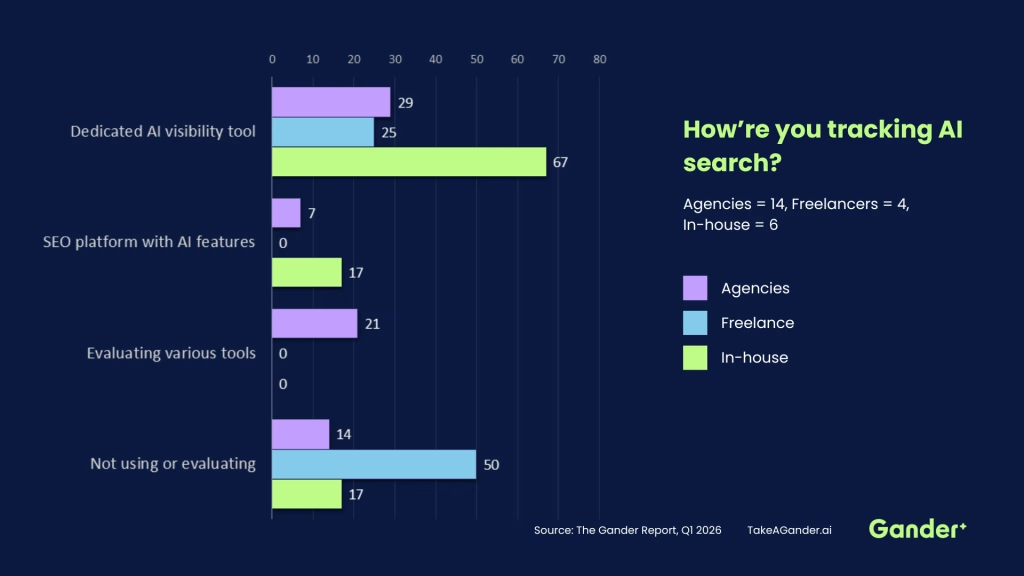
Are you using an AI analytics or visibility tool?
Tool usage | Agency Q1 (Q4-25) | Freelance Q1 (Q4-25) | In-house Q1 (Q4-25) |
|---|---|---|---|
Dedicated AI visibility tool | 29% (27%) | 25% (17%) | 67% (0%) |
SEO platform with AI features | 7% (27%) | 0% (33%) | 17% (40%) |
Manual tracking only | 0% (18%) | 0% (17%) | 0% (40%) |
Evaluating various tools | 21% (18%) | 0% (33%) | 0% (0%) |
Not using or evaluating | 14% (9%) | 50% (0%) | 17% (20%) |
Author’s note: there was no overlap between the practitioners we spoke with in Q4-25 and Q1-26. The differences cited above cannot be taken as trends. This is a known gap in our methodology, that we hope to rectify moving forward.
That being said, there is one trend worth noting. While the representation of brands with in-house practitioners remained similar, adoption of dedicated AI visibility tools has increased significantly.
Triangulation remains a dominant pattern. Practitioners cross-reference multiple sources including their visibility tool, GSC, server logs, Bing Webmaster Tools, manual spot-checks. All to compensate for any single tool’s limitations.
If a client asked for a report on their AI visibility today, walk me through the specific steps your team would take to create it manually. How long would that take?
Most practitioners still don’t follow a single standard workflow, but specific patterns are emerging at the team level. One agency workflow starts in an SEO platform’s AI module. They search a target keyword, identify related conversational prompts, fold those into content briefs, produce content, then track impressions, clicks, and conversions over time. Another starts with long-query data (8+ words) in Search Console, publishes content matching those queries, then checks server log files for grounding-bot traction.
An in-house respondent’s workflow cross-references visibility tool output with server logs to reference human referral traffic, builds retargeting around top-cited pages, and reports to leadership monthly. The most structured in-house workflows include other practitioners in PR, content, sales, and marketing.
KPIs cluster into five categories across the cohort: visibility, citations, and mentions (universal); share of voice (in-house teams especially); brand sentiment and reputation; conversions or leads (where clients demand explicit ROI); and human referral traffic from server logs.
Some practitioners disclose data limitations to clients up front. Ranking results are positioned as “directional,” visibility tool data as “proxy,” and prompt volumes are increasingly stripped from reports altogether. No interviewee provided a specific end-to-end time estimate for a manual report. One practitioner referenced a 15-to-20-hour benchmark for a full GEO audit.
Compared to Q4 2025: the absence of a standard industry playbook persists, but Q1 shows the start of repeatable workflow patterns with both agency and in-house teams.
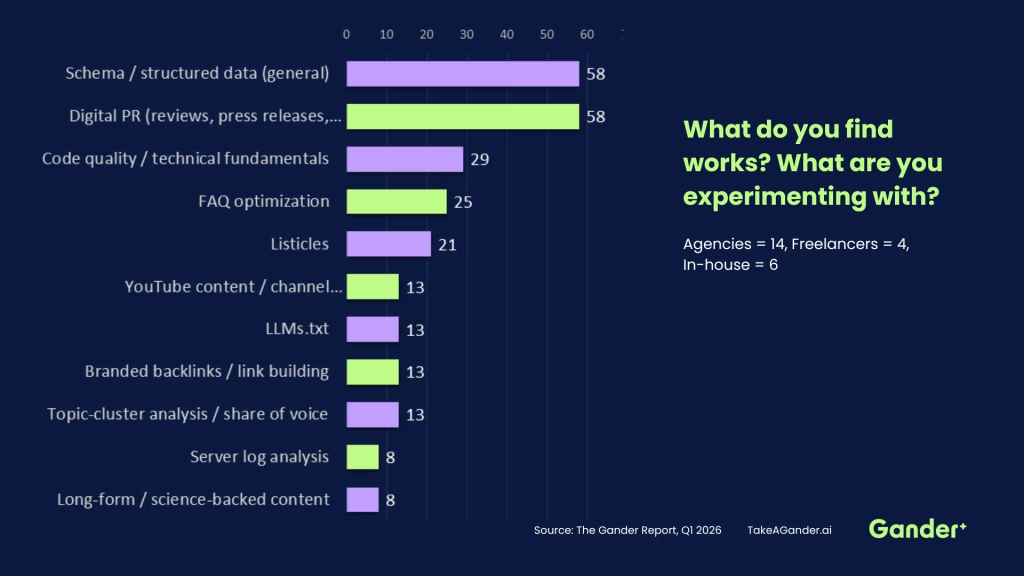
What do you find works? What do you find doesn’t? What’re you experimenting with?
Tactic | Mentions |
|---|---|
Schema / structured data (general) | 58% (14) |
Digital PR (reviews, press releases, linking) | 58% (14) |
Code quality / technical fundamentals | 29% (7) |
FAQ optimization | 25% (6) |
Listicles | 21% (5) |
YouTube content / channel restructuring | 13% (3) |
LLMs.txt | 13% (3) |
Branded backlinks / link building | 13% (3) |
Topic-cluster analysis / share of voice | 13% (3) |
Server log analysis | 8% (2) |
Long-form / science-backed content | 8% (2) |
A pattern worth flagging: every tactic in the top three is an establish practice in traditional search optimization. None of the highest-frequency tactics are exclusive to GEO. The cohort treats GEO success as good SEO weighted differently—schema and PR work get more attention than they did pre-AI, and the technical foundation is described as more important, not less.
Two experiments worth highlighting
Server log analysis for grounding-bot traffic. One agency built a free internal tool that segments server log hits by AI source, showing which content is being crawled by specific generative engines. One in-house team applied the same idea in reverse: connecting its visibility tool to server logs to surface human referral traffic from LLM responses. Both approaches share the same insight, specifically that primary data (actual bot crawls and actual human visits) is more trustworthy than the probabilistic prompt sampling most visibility tools rely on. The in-house version proved especially valuable for executive reporting because it tied citations to measurable downstream behavior.
Establishing a cross-functional team. One in-house team operationalized GEO as a cross-functional program across SEO, web development, PR, and content. Share of voice grew from 15% to 53% over six months. What makes this notable isn’t any single tactic, it’s the intentional organizational design. The team isolated GEO into a coordinated multi-disciplinary committee instead of treating it as one team’s problem. The commendable share of voice increase tells us that it’s worth a resourcing discussion with leadership.
Where do you feel the industry narrative around GEO is overblown, misleading, or unclear?
“SEO is dead” is still universally rejected across the cohort (and rightfully so). Multiple practitioners (agency and in-house) caught colleagues drafting stakeholder-facing materials with that framing and pushed back. Technical fundamentals such as server-side rendering, schema, entity clarity, page structure, are described as more important, not less.
“GEO is just SEO” is challenged as oversimplification. Practitioners acknowledge significant overlap but describe the weights as different: schema, page-template structure, and FAQ formatting now carry more weight than they did in pure SEO.
Everyone is tired of the acronym debate.
AI ranking tools are the most-criticized segment of the market in Q1. Across the cohort they were described as “totally overblown,” “a waste of money,” and “deceptive” on prompt volumes, where vendors charged for data that didn’t exist. SparkToro’s January 2026 visibility-tracking study was cited by multiple practitioners as evidence the category needs methodological rigor; Gander’s rebuttal addresses both the study’s methodology and its conclusions.
Listicle gaming and Reddit citation declines are recurring themes. Practitioners noted Reddit citation share dropped in late January 2026, while listicles continue to drive measurable lift for credible brands but penalty patterns have begun to hit poorly executed cases. Beyond the tool critique, Q1 respondents mentioned industry-related challenges, specifically concerns about long-standing SEO fundamentals (schema, EEAT, internal linking) being re-pitched as new or unique to GEO.
Compared to Q4 2025: the “SEO is dead” rejection and snake-oil vendor critique both persist. What’s trending in Q1: AI visibility tools are now the most-named target of that critique. Organic search and its professionals have a history of pronounced skepticism. Issues with visibility platforms limiting web search and fanouts, promoting skewed prompt data, and a general lack of transparency are ongoing challenges that will need to be addressed.
“[We rely on third-party tools] less and less. Unfortunately pricing has been going up, features have been going down. So… that’s the reason why I try to build my own tools.”
— Pascal Cote, NP Digital
Author’s note
We’re still at the advent of AI search, with an encouraging amount of industry voices (e.g. Lily Ray, Duane Forrester, Rand Fishkin, Eli Schwartz, to name a few) actively experimenting with both novel and established tactics. Research of varying quality is being shared amongst practitioners, with incremental clarity being achieved with each experiment’s replication and subsequent dissemination.
Mental models around “accuracy” persist. Search practitioners are used to a degree of certainty in their tools—GA4, GSC, keyword research planner, all exist in a mature ecosystem. I’m certain that the irony of the challenges GSC faced with data quality isn’t lost on our readers. No single legacy tool is 100% accurate, but they certainly seem more secure and reliable than what exists currently in AI visibility. American political strategist, Lee Atwater, famously said that “perception is reality”. Whether the ecosystem and its tools are reasonably accurate is less relevant than the overwhelming sentiment that it’s all hooey.
This represents a beautiful opportunity for enterprising agencies and in-house brands. There are numerous case studies of brands leveraging AI search with significant conversion and subsequent ROI. It’s not magic but structured experimentation that has led to those results. I’d wager that successful agencies and brands know their customers exceedingly well. They understand the questions asked throughout each part of the buying process and the types of tools used to better understand options and corresponding trade-offs. While others are fearful and skeptical, capitalize on that hesitation and build the skills, knowledge, and corresponding workflows that serve as a foundation to a new facet of organic search.
For those who seem to have infinite stores of skepticism, I applaud that resolve and overall mental cardio. It’s exhausting being cynical.
AI Search as Reputation Management
While not discussed in great detail with all respondents, one or two stated something that I’ve been thinking about a lot: AI search as a proxy for reputation management and ultra-niche solutions.
Drawing from my work using Bloom’s Taxonomy as a framework for prompt development, let’s examine a typical B2B customer journey at a high level. It may look something like: recognition of a problem, attempts to understand potential solutions, exploration of internal capacities, the competitive vendor landscape, and a comparative evaluation of shortlisted options alongside avenues for due diligence.
The last component is by far the most important for both agencies and brands alike.
Due diligence requires a fair amount of work. Hours of searching, reading, validating. The first wave now happens in the span of a single Copilot session. It becomes infinitely easier to disregard a brand that doesn’t uniquely address your issue, telling your personal robot assistant to assess the next batch of vendors.
As AI search continues to evolve and gain mindshare, more companies will vie for your clients or to replace your brand.
I won’t be brash enough to present solutions to such a multi-faceted and complex challenge. It’s enough, at least right now, to understand the actual landscape that lies ahead. AI search assisted buying cycles look different than traditional search. They convert at a much higher rate. They involve a reputation and fit layer that is far easier to evaluate, relative to traditional methods. This changes how we think about the content we write and its distribution.
How are you going to use the next quarter to ensure your brand or your clients are in the conversation?
Takeaways for Continued Research
This report captures a snapshot of Q1 2026 (Feb-Apr). The landscape is still shifting fast enough that several findings may require revisiting within months. A few areas warrant closer investigation:
The ROI gap (carry-over from Q4-25)
Citations and mentions are not clicks. The financial value of appearing in an AI-generated response, versus a traditional organic result, remains debatable. Workflows in Looker Studio and Google Analytics are part of the puzzle.
Platform divergence (carry-over from Q4-25)
ChatGPT, Gemini, Perplexity, and Claude retrieve and synthesize differently. Early findings suggest meaningful variation in how each weights sources, handles brand disambiguation, and display citations. Platform-specific optimization strategies are slowly emerging. I’d like to see more done to showcase the differences and what that means for different verticals.
Personalization as a methodology blocker.
Practitioners across cohorts flagged that LLM responses vary by prior conversation, location, persona context, and account history. No visibility tool simulates this accurately. Several practitioners are running persona-driven prompting, but the methodology is unstandardized. Worth investigating whether persona-based testing can produce comparable results across platforms, or whether personalization makes cross-tool benchmarking structurally unsound.
The custom-tooling pattern.
Roughly a third of the agency cohort told us they’ve built or are building their own visibility and audit tools. The rationale was consistent: commercial tools either won’t disclose how their numbers are sourced, price beyond what mid-market clients can absorb, or produce numbers from clickstream proxies without disclosure.
This was genuinely surprising to me. Extraction logic and brand parsing is complex and it requires ongoing review. Vibe coding a tool in a couple of weeks and presenting it to clients as a proxy for professionally developed tools seems ambitious to me. I’d love to see those tools undergo the same rigour as any of the commercial tools, publishing a comparative study. Even one industry would be a great starting point.
If you’ve built a tool for your agency and would like to do a comparative study with Gander, please DM me on Linkedin.
Ghost sentiment
Ghost sentiment is a term that one independent practitioner introduced for outdated review data and editorial summaries arising from years-old content that still appears in LLM responses, even after the underlying business issues have been resolved. As LLM training cycles lengthen and web search expands, this becomes a brand-protection problem worth its own investigation.
“[If] SEO is dead, [why are] AI companies are hiring for SEO?”
Would you like to help shape the next report?
We’re planning Q2 2026 research and want to hear from you. What questions are you struggling to answer? What would make this research more useful for your work?
Reach out via Linkedin or fill out the form below.
About the Author: Adam Malamis
Adam Malamis is Head of Product at Gander, where he leads development of the company's AI search intelligence platform for tracking brand visibility across generative engines, like ChatGPT, Gemini, and Perplexity.
With over 20 years designing digital products for regulated industries including healthcare and finance, he brings a focus on information accuracy and user-centered design to the emerging field of Generative Engine Optimization (GEO). Adam holds certifications in accessibility (CPACC) and UX management from Nielsen Norman Group. When he's not analyzing AI search patterns, he's usually experimenting in the kitchen, in the garden, or exploring landscapes with his camera.