
37% of consumers now start their searches with AI tools instead of a traditional search engine like Google, according to a 2026 survey of active AI users. If your brand isn’t showing up on tools like ChatGPT and Gemini, you don’t exist to more than a third of people who begin their research there instead of on a search engine results page.
Boosting your AI visibility starts with finding out if and how your brand shows up in AI search results. This is where Generative Engine Optimization (GEO) tools like Gander and AthenaHQ come in. By showing you how visible your brand is on LLMs and what you can do about it, these tools help you optimize for GEO and drive more qualified traffic from AI answers.
In this guide, we compare Gander vs. AthenaHQ, and see how the two tools stack up on LLM coverage, pricing predictability, reputation management, and more.
TL;DR: Which GEO tool fits your business?
Both Gander and AthenaHQ track how your business shows up across AI platforms, and both give you every major engine right from their entry-level paid plan; neither gatekeeps LLM coverage the way some competitors do. But the two tools differ in a few real ways.
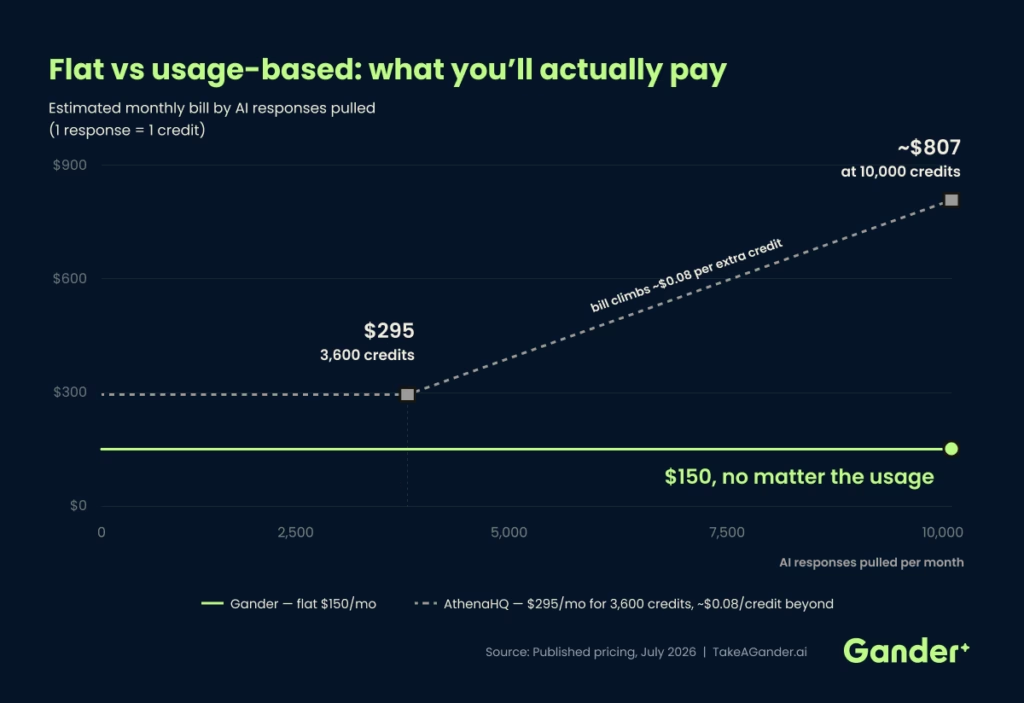
Gander charges a flat monthly fee no matter how much you use the tool, and its onboarding runs your prompts multiple times upfront for accuracy. AthenaHQ runs on a credit system, where every AI response you pull costs a credit, so your monthly bill can move with your usage instead of staying fixed. AthenaHQ, in turn, offers a genuinely deep “Action Center” workflow that turns visibility data into assignable, trackable optimization tasks, plus an “Ask Athena” conversational assistant for querying your own visibility data in plain language. Gander counters with a technical site audit (schema, semantic HTML, WCAG accessibility) and multi-country support built into every plan, not gated to the top tier.
A quick glance at Gander vs. AthenaHQ
Feature | Gander | AthenaHQ |
Stand-out feature | Flat, predictable monthly pricing with full LLM coverage and a technical site audit (schema, semantic HTML, WCAG) on every plan | “Action Center” workflow that converts citation data into specific, assignable page-level fixes, plus “Ask Athena,” a conversational AI assistant trained on your own visibility data |
LLM coverage | ChatGPT, Gemini, Perplexity, Google AI Overviews, and Google AI Mode (in beta), no matter your plan | ChatGPT, Perplexity, Google AI Overviews, Google AI Mode, Gemini, Claude, Copilot, and Grok, also no matter your plan, starting on its lowest paid tier |
Pricing | Starts at $150/month, flat | Starts at $295/month for 3,600 credits, roughly $0.08/credit; billing scales with usage |
Onboarding | Runs your prompts multiple times initially, and daily after that | Runs prompts daily; a discounted $95 first month lets you test the platform before paying full price |
KPIs tracked | Citations, visibility, mentions, average positioning, with sentiment analysis in beta | |
Competitive benchmarking | Tracks competitors’ visibility, citations, and mentions to see how their AI visibility compares to yours. Can view full responses for competitors. | |
Optimization solutions | Comprehensive technical optimization: AI search console-style audits, schema/semantic HTML/WCAG fixes, plus 1:1 GEO coaching on paid plans | Action Center generates prioritized content fixes; autonomous agents can draft corrections directly; Enterprise adds a citation-probability engine |
Integrations | GSC and BWT in beta | GA4, Google Search Console, Shopify, and Webflow on every plan; BI tool support at Enterprise |
Best for | Small-to-mid-sized in-house teams, agencies, government organizations, and anyone who wants a fixed monthly bill | Single-market brands and agencies that want a built-in action workflow and can tolerate variable, usage-based billing |
Now, let’s compare each feature of the GEO tools in detail.
Core methodology
Both Gander and AthenaHQ work by running your prompts through generative AI tools to see if and how you’re showing up on AI search engines, then layering in competitor and citation data on top of raw mentions.
Gander scans your website, or your Google Search Console/Bing Webmaster Tools data, to build relevant prompts for your brand. You can also paste in keywords or write your own prompts, and tweak any of them at any time. Gander doesn’t reduce the number of query fan-outs per prompt or otherwise adjust default LLM parameters, which keeps its data closer to what an actual user would see. Fan-out queries matter because when you ask an AI chatbot a question, the model typically breaks it into several sub-questions, gathers an answer for each, and stitches the results into one response; limiting how many of those sub-questions run is like judging a book by reading one chapter instead of the whole thing.
AthenaHQ builds its methodology around what it calls “Answer Engine Optimization” (AEO): tracking prompt-level visibility, citation probability, and sentiment across eight AI engines, then routing findings into its Action Center. Its Enterprise-only citation-probability engine models how likely specific content is to get cited by a given model, which is a genuinely different bet than Gander’s approach, betting on predicting future citations rather than maximizing the accuracy of what’s happening right now.
 Winner: Either. It’s a tie, because both platforms are built around the same core idea (tracking real prompts across real AI engines) and each brings a genuine methodological strength: Gander’s unmodified-parameter approach for raw accuracy, AthenaHQ’s citation-probability modeling for prediction. Which one matters more depends on whether you value accuracy of current-state data or predictive modeling for future content.
Onboarding
The onboarding process is quick on both platforms. Once you sign up, both tools ask you to enter the brand and website you’d like to track.
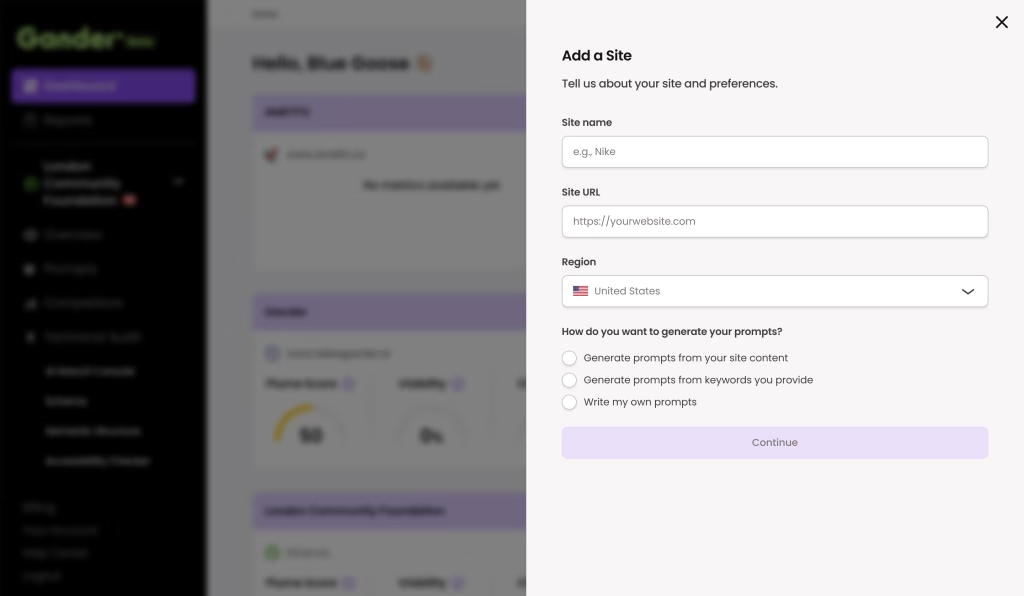
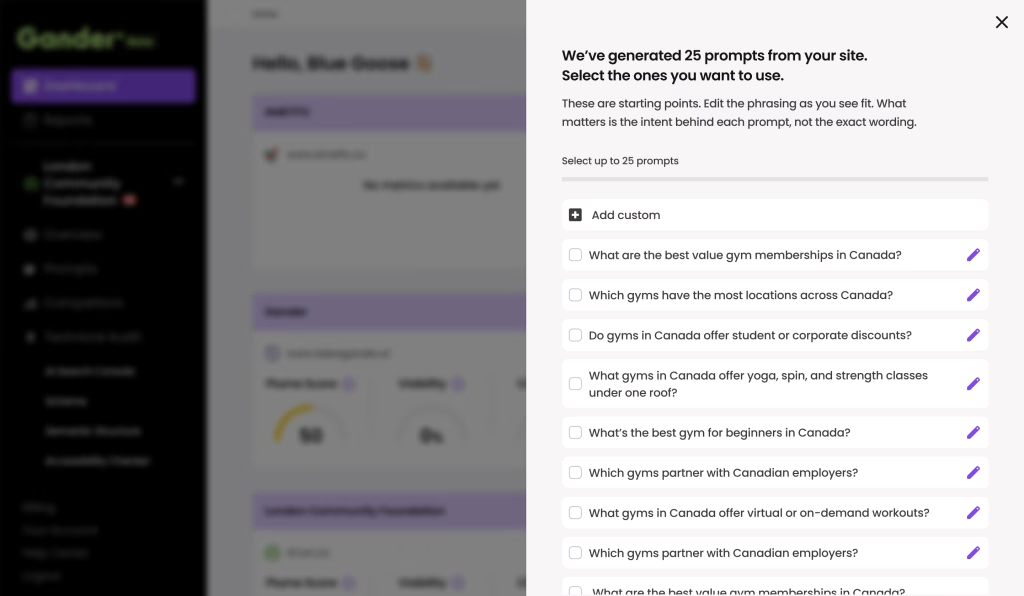
Gander gives you multiple options for prompt creation: let the tool analyze your site and generate prompts, add your own keywords and let Gander build prompts from them, or write custom prompts from scratch. You can tweak your prompts any time. Gander also runs each prompt several times during the initial onboarding run (rather than once) to account for the fact that AI tools can give different answers to the same question, then continues tracking daily after that.
AthenaHQ doesn’t currently offer a genuinely free tier; instead, new accounts get a discounted first month at $95 before rolling onto the full $295/month Self-Serve rate, giving you a lower-cost trial window rather than an indefinite free plan. That’s a meaningful distinction if you were budgeting around a permanently free option: the actual offer is “try it cheap for 30 days,” not “use it free forever.” Its paid tier adds API access and deeper integrations on top of that same onboarding flow, with credits ticking down from day one of the trial month.
Winner: Gander, because its multiple-run onboarding gives you more reliable data out of the gate without requiring a paid commitment, while AthenaHQ’s discounted first month still puts a card on file and a clock on the credits you’re testing with.
Dashboard navigation
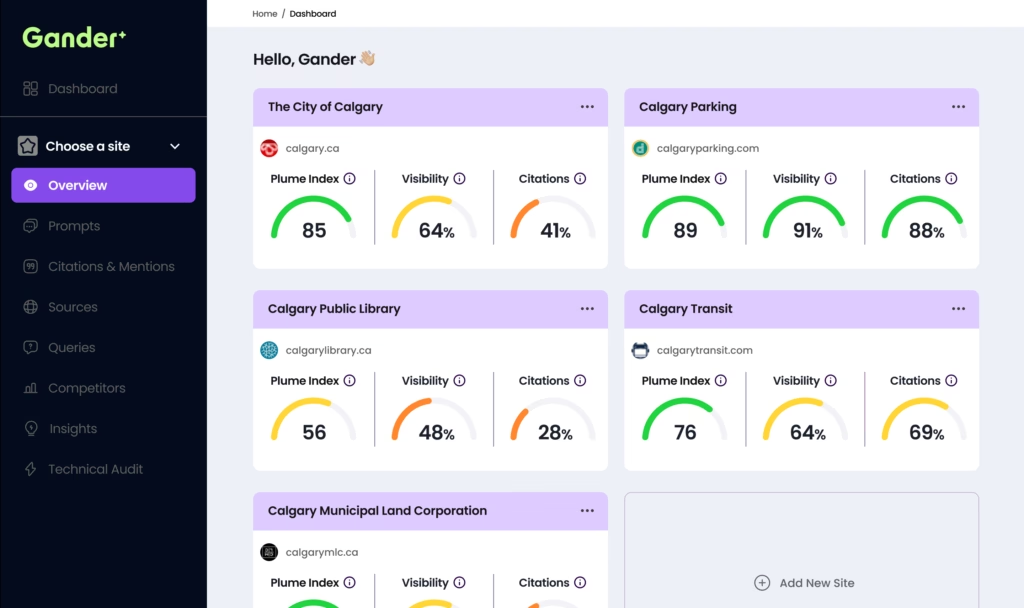
Gander’s dashboard is organized around a single home view: overall AI visibility score up top, then citations, mentions, and average positioning broken out by LLM, with a competitor comparison panel and full response transcripts one click away. Because Gander ships a smaller, more focused feature set than some competitors, the dashboard doesn’t bury you in tabs you’ll never open; everything on screen maps to a metric you’re actually tracking.
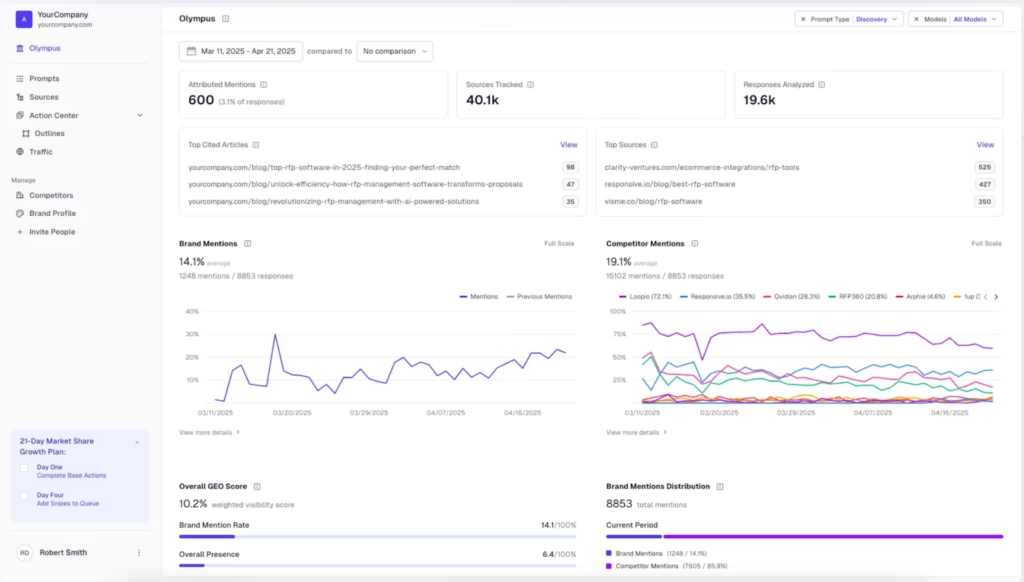
AthenaHQ’s dashboard, built around what it calls the “Olympus” view, centralizes AI visibility, citations, sentiment, and share-of-voice trends in one place, and independent reviewers rate its ease of use at 4.3 out of 5, with one reviewer describing it as answering plain questions like “How are we described?” and “Where are we winning?” without requiring users to dig through raw data first. That “ease of use” praise shows up repeatedly in independent user feedback too: G2’s aggregated review data logs nine separate mentions of AthenaHQ’s “straightforward interface and intuitive navigation” as a top-five advantage of the platform.
The trade-off is pace of change. The same G2 review data shows three mentions of AthenaHQ’s frequent feature releases making it hard for users to keep track of what’s new, with one reviewer suggesting the company send a newsletter just to keep up. That’s a different complaint than confusing navigation, it’s closer to a fast-moving product outrunning its own release notes, but it means the dashboard you log into this month may have shifted from the one you learned last month. Gander’s smaller surface area means there’s simply less dashboard to keep re-learning.
Winner: It’s a tie, because both dashboards get genuine, independently-verified praise for being easy to use; the real difference is that Gander’s leaner feature set stays put, while AthenaHQ ships fast enough that even happy users say the interface is a moving target.
LLM coverage
No matter which pricing plan you choose, Gander tracks your AI visibility across ChatGPT, Gemini, Perplexity, Google AI Overviews, and Google AI Mode (in beta).
AthenaHQ tracks an even broader set, ChatGPT, Perplexity, Google AI Overviews, Google AI Mode, Gemini, Claude, Copilot, and Grok, and, importantly, does not gate any of these platforms behind higher-priced tiers. Every paid plan gets all eight, with additional models available on request for Enterprise customers.
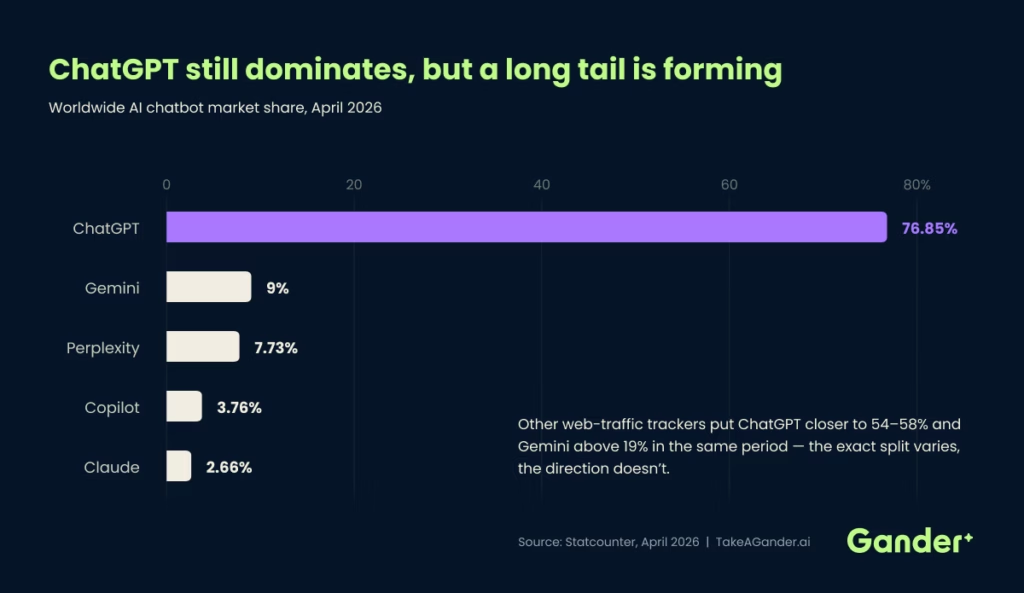
This matters because AI traffic doesn’t sit on one platform, and the split is shifting fast. Global tracking from Statcounter put ChatGPT at roughly 76.85% of worldwide AI-chatbot share as of April 2026, with Gemini at 9%, Perplexity at 7.73%, Copilot at 3.76%, and Claude at 2.66% by that measure; other web-visit trackers cited in the same period put ChatGPT closer to 54-58% and Gemini above 19-28%, depending on methodology and region. The two data sets disagree on the exact split, but they agree on the direction: ChatGPT’s share is shrinking and Gemini’s and Claude’s are both growing quickly. Enterprise buyers also increasingly encounter Copilot inside Microsoft 365 workflows, a channel neither Statcounter’s nor Similarweb’s consumer-traffic numbers fully capture. AthenaHQ’s inclusion of Claude, Copilot, and Grok on every plan means you’re not blind to conversations happening on platforms Gander doesn’t yet track.
Winner: AthenaHQ, because it tracks three more major AI platforms (Claude, Copilot, Grok) than Gander, on every plan, without any paywalling; a meaningfully wider net for brands that need visibility beyond the core four-and-a-half engines Gander covers..
KPIs tracked
Metric | What it means | Gander | AthenaHQ |
Citations | How often and where your brand is cited in AI answers | Yes | Yes |
Mentions | Raw brand mentions across tracked prompts | Yes | Yes |
AI visibility score | A composite score for overall AI presence | Yes | Yes (as part of GEO Score / share of voice) |
Average positioning | Where your brand lands relative to competitors in a response | Yes | Yes (via competitor benchmarking) |
Share of voice | Your citation share versus competitors | Not a named metric | |
Brand sentiment analysis | Positive/negative tone in how AI describes your brand | In beta | |
Prompt volume estimation | Estimated search/prompt demand for your category | Not offered | |
Hallucination / factual-accuracy monitoring | Flags fabricated claims or incorrect positioning about your brand | Not a dedicated feature |
AthenaHQ’s hallucination detection is worth explaining in plain terms: rather than only telling you that your brand was mentioned, it flags cases where an AI answer states something about your brand, your pricing, or your claims that’s factually wrong, so you can correct the source content before the error spreads across more prompts. That’s a different job than sentiment tracking (which measures tone) or citation tracking (which measures whether you showed up at all); it’s specifically about catching AI-generated misinformation about your own brand.
Winner: AthenaHQ, since it tracks a wider set of KPIs out of the box and pairs sentiment analysis with hallucination detection built into the core product, a more mature reputation stack than Gander currently ships. Gander’s sentiment tracking is still in beta by comparison, so this isn’t a close call today, even though Gander’s own reputation-management work (tracking sentiment across both AI responses and third-party links, and producing full citation/reputation reports for client-facing use) is a real, developing strength worth asking about directly if reputation is your primary use case.
Competitor analysis
Both tools give you insight into how you’re performing against competitors on AI search engines.
Gander has a dedicated competitive analysis section that automatically identifies your rivals and shows comparison data across overall performance and individual prompts, including full competitor response views.
AthenaHQ offers unlimited competitor tracking, “impersonation” detection, and benchmarking on every plan, including the entry-level Self-Serve tier, plus regional segmentation for brands that need to compare performance market-by-market. One G2 reviewer’s use case makes the regional feature concrete: a multi-location retailer found its AI visibility in the Southeast was roughly half of what it was on the West Coast, despite similar store density, and traced the gap to specific product-category content missing from its Southern-market pages.
Winner: It’s a tie, since both platforms provide genuinely useful, unlimited-feeling competitor tracking. The meaningful difference is AthenaHQ’s regional segmentation, which only matters if you operate in multiple markets, and notably, AthenaHQ’s own entry plan restricts you to a single country, which limits how far you can actually use that regional view without upgrading to Enterprise.
Optimization
Gander audits your entire website, including technical elements like semantic structure, schema markup, and WCAG accessibility compliance, then gives you clear recommendations for fixing what’s holding your AI visibility back. Its Optimize and Authority plans also include 1:1 coaching with GEO/search experts.
AthenaHQ’s Action Center takes citation and visibility data and converts it into prioritized, specific recommendations, organized as assignable tasks with context on what to fix, why it matters, and expected impact, and its content agents can draft GEO-optimized content directly. One reviewer’s example: if AthenaHQ detects that Perplexity is citing outdated pricing on your site, the Action Center can draft a schema-optimized correction ready to deploy to your Help Center or FAQ page. Ask Athena, its conversational AI copilot, lets you query your own visibility data in plain language, asking things like “which prompts are driving the most competitor citations,” instead of digging through dashboards. Its most advanced optimization technology, a citation-probability engine that models how likely content is to get cited, is reserved for its Enterprise tier.
Gander’s optimization sits on the technical side: it audits your site’s schema, semantic HTML, and WCAG accessibility and returns concrete fixes, with 1:1 coaching on higher plans. The two approaches differ — AthenaHQ leans into an assignable content-fix workflow, Gander into the technical readiness that determines whether a model can crawl and cite you at all.
Winner: It’s a tie, they optimize different halves of the problem: AthenaHQ the content-action workflow, Gander the technical foundation.
Integrations
AthenaHQ integrates with GA4, Google Search Console, Shopify, and Webflow on every plan, with BI-tool support at Enterprise. Gander currently integrates with Google Search Console and Bing Webmaster Tools (in beta), with more planned.
Winner: AthenaHQ, for its broader out-of-the-box integration set.
Pricing
Gander is flat: $150/month on the entry plan, with the same coverage regardless of usage. AthenaHQ runs on credits, starting around $295/month for 3,600 credits (roughly $0.08 each), with a discounted $95 first month, so the bill scales with how much you pull. Flat pricing is easier to budget; usage-based can be cheaper at low volume and more expensive as you scale.
Gander plans (flat monthly, 14-day trial)
Plan | Pilot | Optimize | Authority |
Price | $150/month | $500/month | $1,000/month |
Number of prompts | 10 per LLM (40 total) | 50 per LLM (200 total) | 100 per LLM (400 total) |
Number of AI engines tracked | 4 | 4 | 4 |
Cadence | Daily | Daily | Daily |
Number of sites | 1 | Unlimited | Unlimited |
Number of competitors | 10 | 30 | Unlimited |
Number of languages | 1 | 1 | 1 |
GEO coaching | None | 30 min/month | 1 hour/month |
AthenaHQ plans (credit-based, 1 credit = 1 AI response)
Plan | Essential (Free) | Starter | Enterprise |
Price | Free (includes $25 credit) | $295/month ($245/month billed annually) | Custom |
Credits (1 credit = 1 AI response) | 300 | 3,600 per month | Custom |
Number of AI engines tracked | 5 | 9 | 9 or more |
Cadence | Daily | Daily | Daily |
Number of sites | Not published | Not published | Not published |
Number of competitors | Competitor insights included | Unlimited | Unlimited |
Number of languages | 1 (single region) | 1 (single region; multi-region add-on) | Multi-region and multi-language |
Seats | Unlimited | Unlimited | Unlimited |
Winner: Gander, for teams that want a predictable monthly bill; AthenaHQ if you’d rather pay for exactly what you use.
Verdict: Which tool should you choose?
Choose Gander if you want flat, predictable pricing, a technical site audit on every plan, and the same engine coverage without gating. Choose AthenaHQ if you want the widest engine coverage (Claude, Copilot, Grok included), hallucination detection, and a built-in action workflow, and can work with usage-based billing.
Lead in AI search with predictable, full-coverage visibility tracking. Try Gander risk-free and see how you show up across every major AI engine.