
A growing number of teams evaluating Gander aren’t comparing us to another AI-visibility platform at all. They’re asking a different question: why pay for one when Claude Code can apparently build one over a weekend?
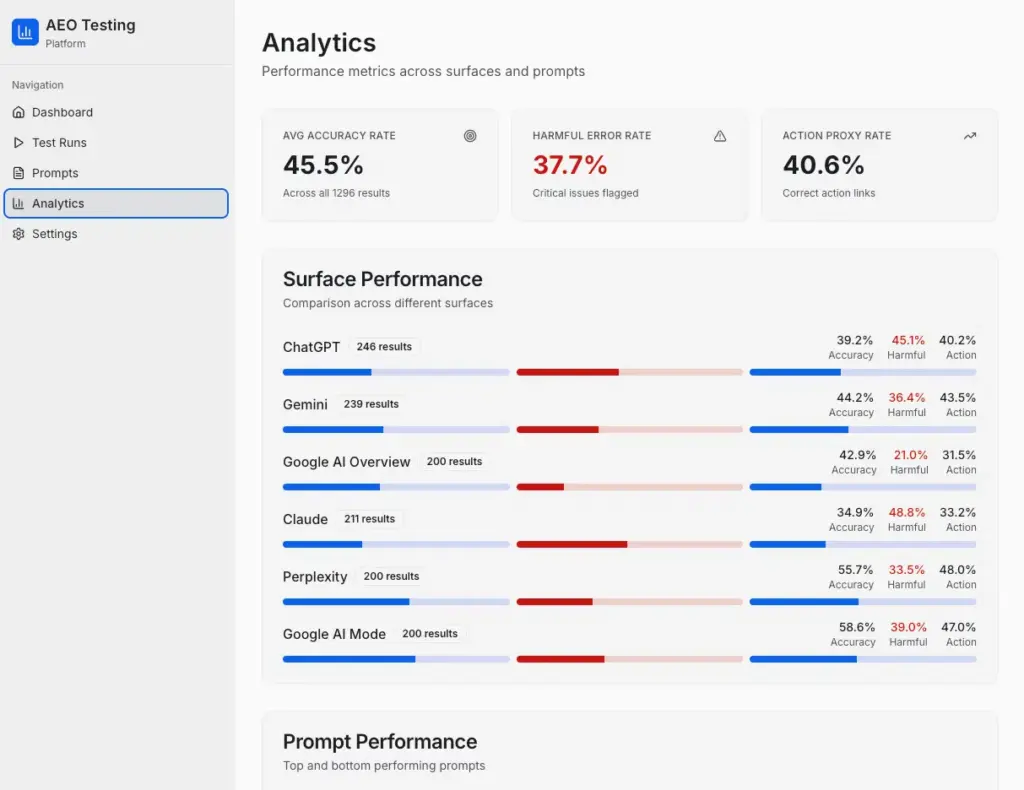
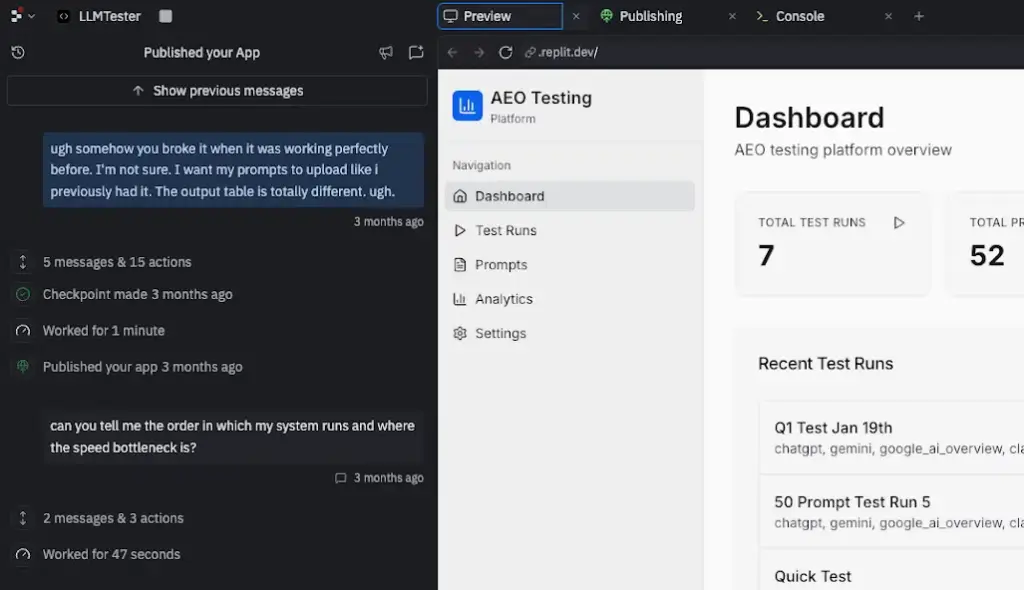
It’s a fair question, and it deserves a fair answer instead of a defensive one. In April 2026, Search Engine Land published a widely-read piece by Julian Hooks, Director of SEO and AEO at Asurion, walking through exactly this: he’s not a developer, he spent a weekend (plus “several evenings”) “vibe coding” with an AI agent, and he came out the other side with a working tracker pinging ChatGPT, Claude, Gemini, Google AI Mode, and Google AI Overviews for about $80 a month against a “mid-tier SaaS tool” he’d been quoted $500 for. That’s a real, credible, well-documented build, not a hypothetical, and it’s worth reading in full before deciding whether it’s the right call for your own team.
So let’s take it seriously. Then let’s talk about what happens six months later, when that tracker is a production dependency and not a weekend project.
The prototype is genuinely easy to build
This is worth saying plainly: Claude and Claude Code are very good at exactly this kind of task. Point Claude Code at API documentation, describe a scoring rubric, and it will scaffold a working app — auth, a database, a results table, a dashboard — in an afternoon. Hooks’s own build used Replit’s AI agent rather than Claude Code specifically, but the underlying capability is the same: describe what you want in plain English, and an agentic coding tool will stand up the scaffolding. Anthropic doubled Claude Code’s usage limits across paid plans in May 2026, and current API pricing runs from roughly $1 per million input tokens on the smallest model up to $5 on the flagship (with output priced several times higher), which makes the raw cost of pinging a handful of LLM endpoints for brand mentions genuinely trivial at low volume. If your test is “can an agentic coding tool stand up a script that asks ChatGPT and Claude the same ten questions every day and logs the answers,” the answer is unambiguously yes, and it’s been yes for a while.
If you’re a technical team with a narrow, well-defined tracking need and someone willing to own it, don’t let anyone talk you out of trying this. It’s a legitimate path, and Gander itself is built on the same APIs. We’re not going to pretend otherwise.
What “done” actually requires
Where the weekend-project framing breaks down is the gap between a script that works once and a system whose numbers a marketing team, an agency, or a client will actually trust every day for a year. That gap is where most of the real engineering work (and most of the reasons companies eventually buy rather than build) actually lives.
- Five engines, five sets of rules, and no clean API for two of them. Gander tracks ChatGPT, Gemini, Perplexity, Google AI Overviews, and Google AI Mode — the same five surfaces Hooks identified as the ones that matter for AEO testing. ChatGPT, Claude, and Gemini all have official, documented APIs. Google AI Overviews and Google AI Mode do not. There is no first-party Google API for either one; the DataForSEO-style tools that Hooks relies on to pull AI Mode and AI Overview data are third-party layers sitting on top of Google’s consumer search surface, and they’re a separate integration with their own reliability characteristics, pricing, and breakage risk, on top of (not instead of) the three model APIs you’re already maintaining. That’s five surfaces, effectively five different data contracts, and no single vendor guaranteeing any of them stays stable. Even within the officially-supported APIs, the contract shifts under you: model versions get deprecated on their own schedules, and pricing itself moves. Anthropic’s own introductory API pricing is explicitly time-boxed before standard rates kick in, which is a small planning detail until you’re the one who has to notice it happened.
- This is also the exact place where the “just scrape it” shortcut runs into the terms of service. It’s tempting, once you hit a wall with an official API, to fall back to automating the consumer chat UI instead: logging into ChatGPT.com or Claude.ai with a script and reading the page. Don’t. OpenAI’s Terms of Use prohibit “any automated or programmatic method to extract data or output from the Services, including scraping, web harvesting, or web data extraction,” except as permitted through the API. Anthropic’s Consumer Terms (Section 3.7) prohibit accessing Claude.ai “through automated or non-human means, whether through a bot, script, or otherwise,” with the only carve-outs being an official API key or explicit permission — and Anthropic has been actively enforcing this line, including a well-publicized 2026 crackdown on third-party harnesses riding on consumer subscription tokens rather than paying for API access directly. Perplexity’s Terms of Service similarly bar any “robot, spider, crawlers, scraper, or other automatic device, process, software or queries” used to mine, extract, or monitor the service. None of this is a gray area or a technicality; it’s the difference between a sanctioned integration and one that can get an account suspended mid-project. A DIY build has to solve for this exactly the way Gander does: API-first, full stop, which is also exactly why Google AI Overviews and AI Mode are the two hardest surfaces to track well. There’s no equivalent sanctioned API path yet, only third-party middlemen standing in the gap.
- Non-determinism isn’t a bug you patch once. It’s a standing research problem. Ask an LLM the same question twice and you can get two different answers, two different sets of citations, sometimes a different brand mention entirely. A single run per prompt per day tells you what the model said once, not what it reliably says. Getting a stable signal means running enough samples per prompt to separate real movement from noise, which is itself a sampling-methodology question, not a solved default, and it’s a problem that scales badly: five engines times enough repeat runs per prompt to trust the average is a meaningfully larger and more expensive query volume than the single-pass version most DIY builds start with. Gander runs each prompt six times during onboarding specifically to establish a baseline before shifting to daily monitoring, using a heavily-tested custom system prompt tuned to approximate how a real user would actually phrase the question, tuning that came out of real trial and error across five engines, not a single afternoon’s prompt-writing. Gander’s own FAQ on data accuracy makes this exact point to prospects: ask the same question into any generative engine more than once and you’ll get different responses, and most companies tracking this on their own only run one prompt a day.
- Parsing the answer is its own project. A model’s raw response is unstructured text. Turning that into “did our brand get mentioned, in what position, alongside which competitors, backed by which cited source, with what sentiment” is a parsing and classification problem that gets harder, not easier, as you add engines, because each one formats citations differently. Hooks’s own field-guide of what broke during his build is instructive here: Gemini’s API returned long, encoded redirect links instead of usable source URLs, forcing him to build a custom redirect-resolver as a post-processing step just to get a clean citation; separately, ChatGPT’s API didn’t return the same web citations that the public ChatGPT.com interface displayed by default, which he only caught by manually cross-checking outputs. Both are the kind of silent mismatch that doesn’t throw an error; the app just quietly under-reports citations until someone happens to notice the gap. That’s not a one-time fix; every provider update is a fresh chance for the parsing layer to go wrong again in a slightly different way.
- Knowing your AI visibility is only half the job — you still have to act on it. Even a perfectly reliable tracker only tells you where you stand. It doesn’t audit whether your schema markup, semantic HTML, and WCAG accessibility are actually structured in a way these models can parse and cite. That’s a second, unrelated engineering project (a technical site-audit tool) that has nothing to do with prompting an LLM and everything to do with crawling and evaluating your own site’s markup against evolving best practices for how generative engines read a page. Hooks’s piece is explicitly scoped to the tracking half of the problem; the audit half doesn’t come up because it’s a different tool with a different engineering skill set (crawling and markup analysis, not prompt orchestration), which is easy to overlook if the DIY build only solves the half that was top of mind when the weekend started.
- And then someone has to keep maintaining it. Every one of the five providers changes things: deprecates a model version, adjusts a rate limit, alters what a default API call returns versus what the consumer product shows (a gap Hooks hit directly, per the citation mismatch above). Each change is small, but multiplied across five surfaces, over years, it adds up to a permanent maintenance job that isn’t anyone’s actual title. Hooks is candid about this cost in his own writeup: the biggest expense of the DIY path isn’t the roughly $80 a month in hosting and API usage, it’s the time. There’s no customer support line to call when something breaks, and whoever built it is now the only person who can fix it.
- None of this means the DIY path is a trap. It means “build a tracker” and “build a tracker you can still trust in month eight” are different projects, and the second one is real, ongoing engineering work — the kind Hooks’s own honest cost breakdown calls out as the biggest line item, before you even get to a technical audit engine or reputation tracking layered on top.
When building it yourself is the right call
Sometimes it is. If you have genuine engineering capacity to spare, a narrow and stable set of prompts you need to track, and (this matters) you want full control over the exact methodology rather than trusting someone else’s black box, building your own is a defensible choice. Hooks needed a custom five-point scoring rubric (brand name inclusion, accuracy, pricing correctness, actionability, and quality of citations) that no off-the-shelf tool offered; that’s a legitimate reason to build rather than buy, and it’s exactly the kind of specific, well-scoped need that makes a DIY build defensible rather than a false economy. His own advice for who should build echoes this: do it if you need a custom testing method no SaaS tool offers, you want a white-labeled tool for your own agency, or your budget is tight and you have the time to invest. A team in that position, with someone willing to own the maintenance as an ongoing responsibility rather than a one-time project, can reasonably conclude the DIY path is right for them. We’d rather say that plainly than pretend every build is destined to fail. It isn’t, and pretending otherwise wouldn’t earn anyone’s trust.
The honest question to ask isn’t “can this be built’ — it clearly can, and for the right team it’s a legitimate choice. It’s whether, six months in, you want a bespoke tracker to be a standing engineering dependency your team maintains, or whether you’d rather that effort go into acting on the visibility data instead of keeping the pipes running. If it’s the former, build it. If it’s the latter, that’s the job Gander is built to do.
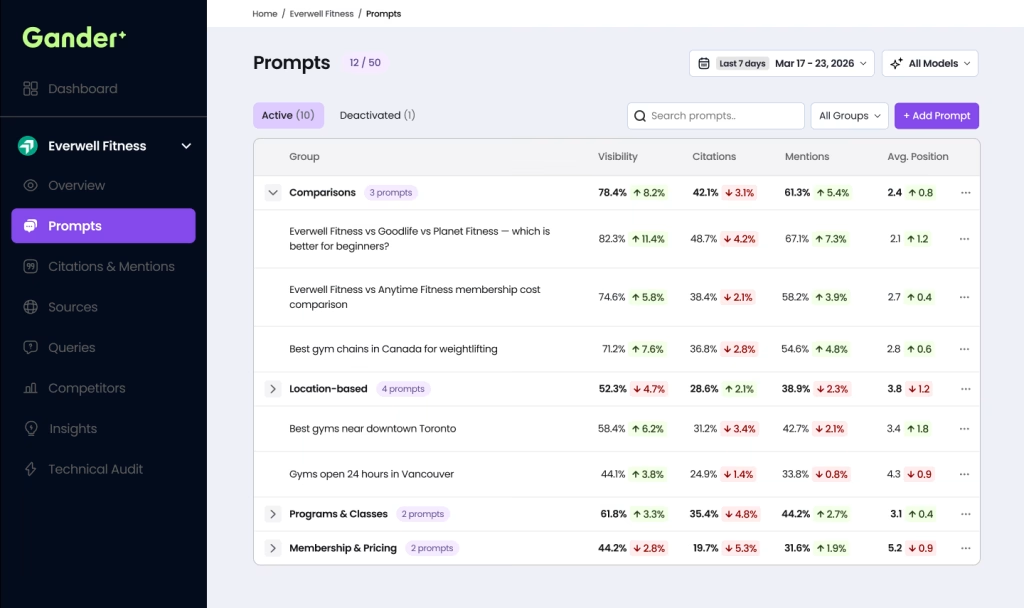
Take a look at Gander and see whether your situation has outgrown the weekend project.